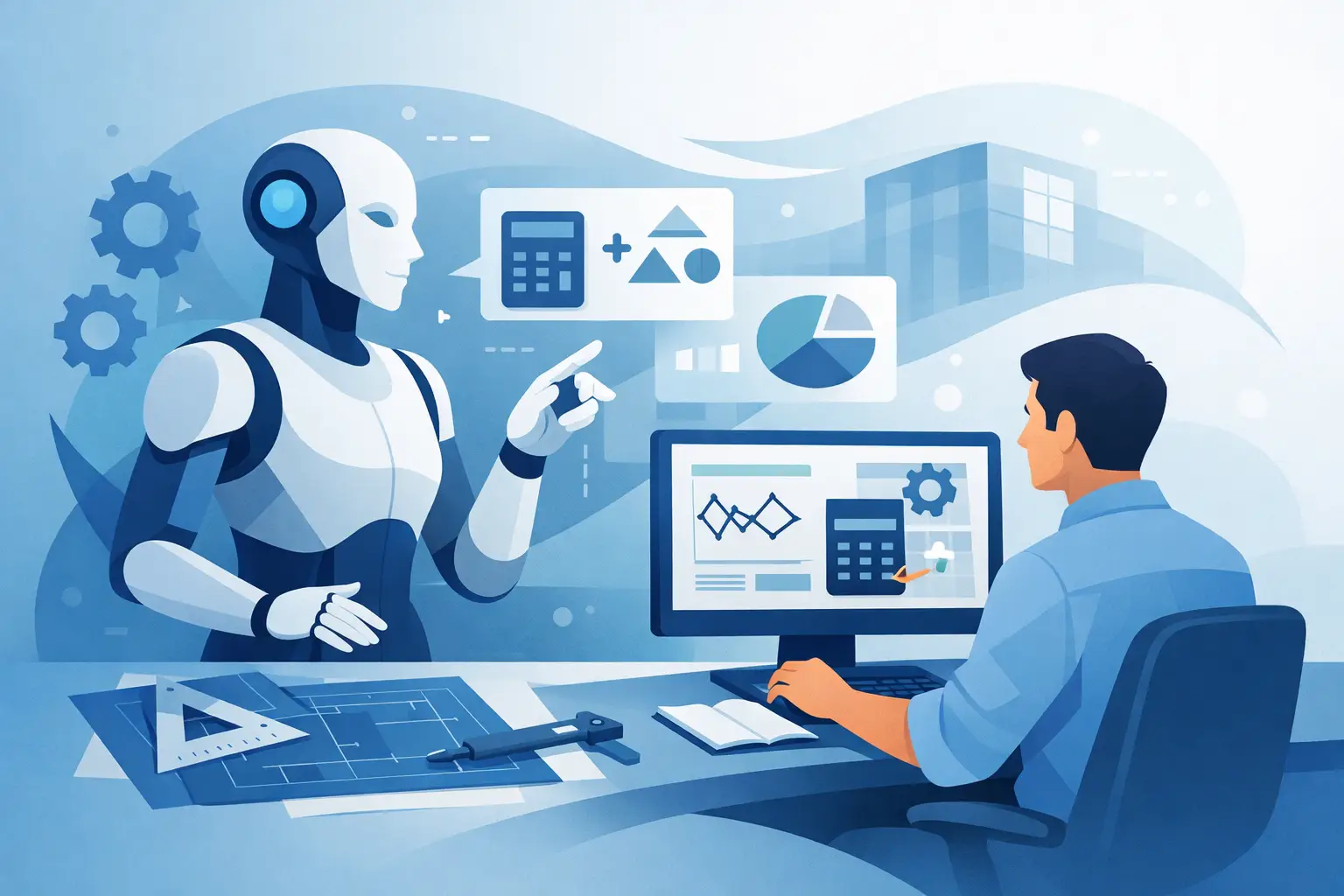
An ai engineering calculation assistant is only useful if it helps with the part engineers actually lose time on: turning working maths into a calculation record that someone else can follow, check and reuse. That is where most tools still fall short. They can compute, but they do not explain. They can automate, but they do not preserve engineering intent.
For many engineers, the friction is familiar. A quick design check starts in a spreadsheet, assumptions end up in a separate note, units are handled manually, and the final result has to be rewritten into a presentable format for review. The arithmetic may be right, yet the calculation package is still weak because the reasoning is scattered. An AI assistant for engineering calculations should reduce that gap, not widen it.
What an AI engineering calculation assistant should actually help with
In engineering work, assistance is not the same as automation. Most users are not looking to hand over design responsibility to a black box. They want support with setup, formatting, consistency and documentation while retaining control over the equations, assumptions and acceptance criteria.
A useful AI engineering calculation assistant helps draft calculation structure, suggest variable definitions, generate readable explanatory notes and reduce repetitive worksheet authoring. If you are checking beam deflection, bolt stiffness, pipe flow losses or a simple section property calculation, the time sink is often not the equation itself. It is creating a clean worksheet that shows inputs, formulas, units, intermediate steps and final checks in a way another engineer can review.
That distinction matters. In most engineering environments, a fast answer with poor traceability is not a finished output. It is only a starting point.
Why generic AI tools are not enough
A general-purpose chatbot can produce equations and explain textbook concepts, but that does not make it suitable for live engineering work. The risk is not only mathematical error. It is context error.
Engineering calculations depend on unit systems, sign conventions, boundary conditions, code assumptions, iteration logic and discipline-specific notation. A generic tool may write something plausible while ignoring whether the units remain consistent, whether the chosen formula matches the scenario, or whether the output is documented well enough for design review.
There is also a workflow problem. Copying fragmented AI output into spreadsheets and reports creates another layer of manual handling. That introduces more opportunities for transcription mistakes and version confusion. If the assistant sits outside the calculation environment, it often adds as much cleanup as it saves.
This is why the better model is an assistant inside a structured worksheet system. The AI helps build and refine the calculation document while the engineering maths, units, notes, plots and outputs remain in one place.
The real value is readable calculation workflow
An engineering calculation is rarely judged only by its final number. It is judged by whether the inputs are visible, the method is sensible, the assumptions are stated and the output can be reviewed without detective work.
That is where a purpose-built platform changes the role of AI. Instead of acting like a detached answer engine, the assistant becomes a drafting and authoring layer within the worksheet. It can help prepare a document that reads like engineering work rather than a pile of cells.
For example, an engineer creating a deflection check may begin with span, load case, material modulus and second moment of area. A useful assistant can help scaffold the worksheet sections, propose formula blocks, add explanatory text around assumptions and keep the presentation consistent. The engineer still verifies the model, selects the governing case and decides whether the result is acceptable. The assistant reduces worksheet friction.
That is a practical gain, especially in teams where calculations are reviewed, shared and revisited months later.
Where an AI engineering calculation assistant fits in practice
The strongest use cases are repetitive but not trivial. These are calculations that engineers perform often enough to value speed, yet carefully enough that documentation quality still matters.
A structural engineer may build repeated checks for bending stress, bolt groups, base plate bearing or serviceability limits. A mechanical engineer may prepare worksheets for shaft sizing, pressure drop, thermal expansion or fastener preload. A civil engineer may document retaining wall checks, simple drainage capacity calculations or concrete section assessments.
In each case, the assistant is most helpful at the worksheet layer. It can accelerate first drafts, standardise notation, produce reusable snippets and help convert rough working into a presentable technical document. That is different from pretending to replace engineering judgement.
There is a trade-off here. The more novel or code-sensitive the problem, the less any assistant should be trusted without close review. For routine internal methods and well-understood checks, assistance can be highly efficient. For unusual geometry, ambiguous loading or code interpretation, the engineer must stay firmly in charge.
What to look for in the underlying platform
If you are evaluating any AI engineering calculation assistant, the assistant itself is only part of the decision. The underlying calculation environment matters more.
First, the maths engine should be unit-aware. This is not a nice extra. Engineering work across SI, USCS and CGS units becomes fragile very quickly without explicit unit handling. If unit conversion depends on memory or manual side calculations, avoidable errors follow.
Second, the worksheet should support more than plain arithmetic. Real calculations often need vectors, matrices, statistical functions, iterative logic, plots and embedded notes. If the platform cannot handle these natively, the workflow will drift back into spreadsheets and disconnected files.
Third, outputs should be readable by another engineer. A calculation sheet should show formulas, assumptions, notes and results in a structured layout that can be printed or shared without rebuilding it elsewhere. This is one of the clearest differences between an engineering worksheet platform and a generic spreadsheet.
Fourth, reuse should be built in. Teams benefit from templates, worksheet copies and standard snippets because most engineering calculations are not invented from scratch each time. The assistant becomes much more valuable when it works with repeatable building blocks.
AI assistance is useful, but reviewability is non-negotiable
There is a temptation to evaluate AI purely on speed. That is the wrong metric on its own. In engineering, a calculation that takes five minutes to generate but thirty minutes to verify may not be an improvement.
The better question is whether the assistant produces work that is easier to review. Does it create transparent formulas? Does it preserve units? Does it separate inputs from derived values clearly? Does it add explanatory notes that help another engineer understand the method? If not, the apparent time saving may be superficial.
This is also where documentation quality becomes a business issue, not just a technical one. Poorly presented calculations slow internal approval, client communication and later project reuse. Clear worksheets reduce rework because the engineering intent stays attached to the maths.
A platform such as Calculeaf is aligned with that need because it treats calculations as technical documents rather than raw cells. In that setting, AI assistance becomes practical. It helps engineers author and refine worksheets that remain unit-aware, structured and shareable.
A sensible way to adopt an AI assistant
The best adoption path is incremental. Start with low-risk, repeatable calculations that already follow a known internal method. Use the assistant to draft worksheet structure, variable definitions and explanatory content. Then compare the resulting sheet against your existing manual workflow.
If the platform improves consistency and saves preparation time without reducing traceability, expand usage to template creation and team-standard snippets. Keep review discipline unchanged. AI should shorten setup and documentation effort, not relax checking standards.
It also helps to be explicit about where assistance ends. Let the system help with worksheet authoring and reusable technical presentation. Keep engineering decisions, code interpretation and final sign-off with the engineer. That boundary is not a limitation. It is what makes the tool usable in professional practice.
An AI engineering calculation assistant is most valuable when it makes calculations easier to read, easier to review and easier to reuse. If it only gives faster answers, it is solving the wrong problem. The better target is a worksheet that carries the maths, the assumptions and the engineering reasoning together, so the next person who opens it can understand the work without guessing.