Adiabatic Flame Temperature Rise Estimate
Adiabatic Flame Temperature Rise Estimate
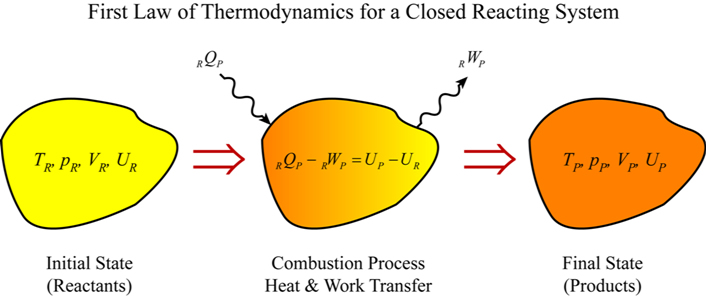
Adiabatic flame temperature is the theoretical maximum temperature combustion products would reach if all the fuel's chemical energy went into heating them with no heat loss to surroundings — a useful upper bound for combustor liner design, emissions estimation, and checking whether a proposed combustion system is even thermodynamically plausible. A simplified energy balance spreads the fuel's heating value across the mass of air and fuel actually present (captured by the air-fuel ratio) and the specific heat of the resulting products, giving a quick estimate without needing a full chemical equilibrium calculation.
The temperature rise is dT = LHV/((AFR+1)·cp), added to the reference (inlet) temperature to give the adiabatic flame temperature. where LHV is the fuel's lower heating value, AFR is the air-fuel mass ratio, cp is the specific heat of the combustion products, and T0 is the reference inlet temperature.
Inputs
LHV_fuel := 44000 kJ/kg=4.4e+07 m^2/s^2
AFR_mix := 15=15
cp_prod := 1.1 kJ/(kg·K)=1100 m^2/K/s^2
T_0b := 298 K=298 K
Dividing the fuel's heating value by the total mass of air plus fuel per unit fuel, and by the products' specific heat, spreads all the released chemical energy across the actual mass being heated to estimate the temperature rise.
dT_flame := LHV_fuel/((AFR_mix+1)·cp_prod)=2500 K
Adding that rise to the initial reactant temperature gives the estimated adiabatic flame temperature.
T_ad := T_0b + dT_flame=2798 K
Results
The estimate here, around 2798 K, is in the right ballpark for hydrocarbon-air adiabatic flame temperatures, though real measured (or chemical-equilibrium-computed) values for lean gasoline-air combustion are typically somewhat lower, near 2200–2500 K, because dissociation of CO2 and H2O at high temperature absorbs energy that this simplified constant-cp model ignores. This estimate is still useful as a quick upper-bound check — if a proposed combustor design implies temperatures anywhere near or above this number, materials and cooling design become the dominant engineering challenge. Running fuel-rich or fuel-lean (AFR far from stoichiometric) lowers the actual peak temperature since either excess air or excess unburned fuel absorbs energy without contributing combustion heat.
Assumptions & limitations
- No heat loss to surroundings (fully adiabatic) — a theoretical maximum.
- Constant specific heat cp assumed, ignoring its rise with temperature.
- Dissociation of combustion products at high temperature is neglected.
- Complete combustion assumed with the given air-fuel ratio.