Anchor Bolt Tension Capacity
Anchor Bolt Tension Capacity
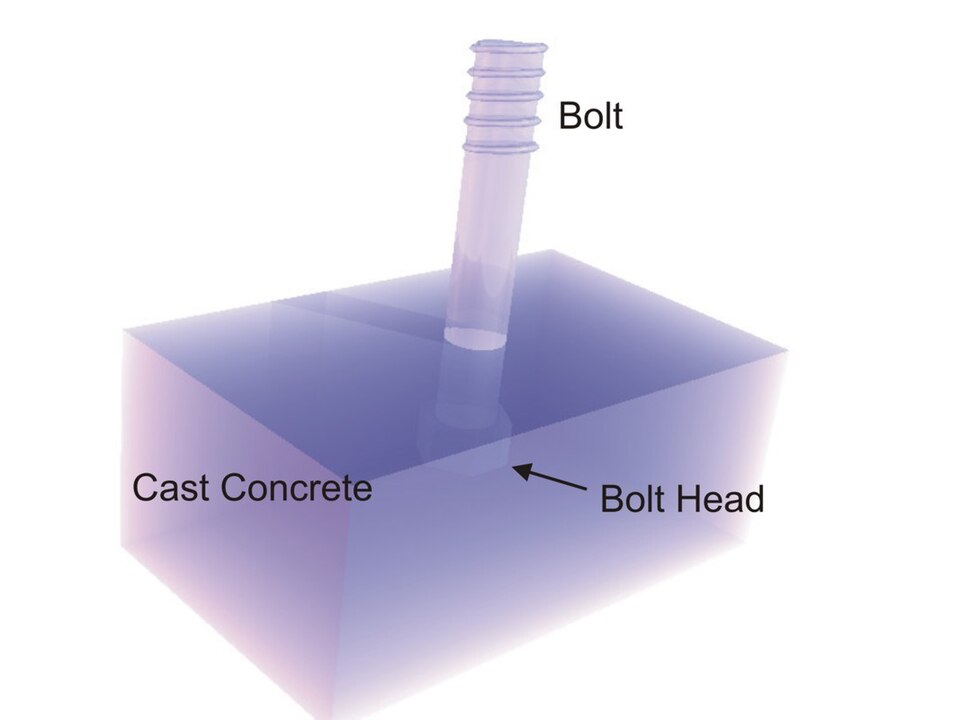
Anchor bolts tie a column base — or any embedded steel element — down into its concrete foundation, and they become the critical load path whenever the structure experiences net uplift, such as from wind suction on a light roof structure or overturning at the base of a braced frame. Unlike bearing, which only resists downward loads, anchor bolts are what keep a lightly loaded column from lifting off its footing entirely.Because uplift events are often transient (a wind gust, a seismic pulse) rather than sustained, anchor bolt failures can be easy to overlook in design if only gravity load cases are checked; a lightweight structure with generous roof overhangs is a classic case where uplift, not gravity, governs the anchorage design.
The uplift force divides among the anchor bolt group, so the tension in each bolt is T = N_up/n_ab, compared against the allowable tension capacity of a single anchor. where N_up is the total net uplift force at the base, n_ab is the number of anchor bolts sharing that uplift, T is the tension demand per bolt, and T_allow is the allowable tension capacity of one anchor bolt.
Inputs
N_up := 120 kN=120000 N
n_ab := 4=4
T_allow := 40 kN=40000 N
Assuming the uplift is shared equally among the anchors, dividing the total uplift by the bolt count gives the tension demand on each anchor.
T := N_up/n_ab=30000 N
Comparing the allowable per-bolt tension with the demand gives the factor of safety against anchor bolt failure.
SF := T_allow/T=1.33
Results
An SF around 1.3, as found here, is a reasonable working margin for anchor bolts, though many designers prefer more reserve here specifically because anchor failure — whether bolt fracture or concrete breakout — is brittle and hard to inspect after the fact. If SF is marginal, adding anchors or moving to a larger bolt diameter is preferable to relying on a thin factor of safety, since concrete breakout capacity (checked separately) often governs before the steel does. This calculation only checks bolt steel tension; concrete breakout cone capacity and edge-distance effects need their own check.
Assumptions & limitations
- Uplift force is assumed shared equally among all anchor bolts (no group eccentricity).
- Only steel tension capacity of the anchor bolts is checked here, not concrete breakout or pullout.
- No coexisting shear on the anchor group is included.
- Anchors are assumed properly embedded and developed per the anchor manufacturer or code provisions.