Brayton Cycle Thermal Efficiency
Brayton Cycle Thermal Efficiency
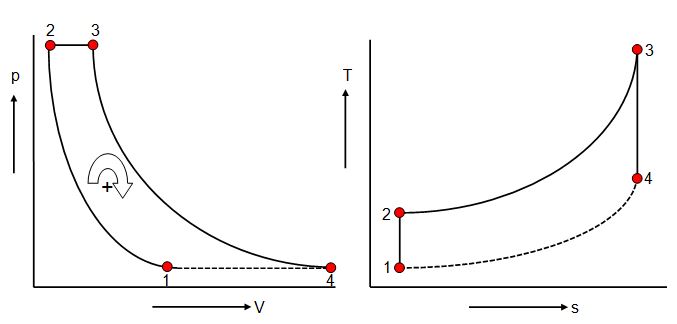
The Brayton cycle describes gas turbines and jet engines: air is compressed, fuel is burned to add heat, and the hot gas expands through a turbine to produce work, and remarkably its ideal thermal efficiency depends on nothing but the compressor pressure ratio and the gas's ratio of specific heats — no absolute temperatures needed. This clean pressure-ratio dependence is why gas turbine designers chase higher and higher compressor pressure ratios: modern aeroderivative and heavy-frame gas turbines run pressure ratios well above 20 specifically because efficiency keeps climbing with rp, even though mechanical and material limits eventually cap how far it can be pushed.
The ideal Brayton efficiency is eta = 1 - 1/rp^((k-1)/k), where rp is the pressure ratio and k is the ratio of specific heats, both dimensionless. where rp is the compressor pressure ratio and k is the working gas's ratio of specific heats (cp/cv).
Inputs
r_p := 10=10
k_gas := 1.4=1.4
Raising the pressure ratio to the (k-1)/k power and inverting it gives the fraction of heat that the ideal cycle cannot convert to work; one minus that fraction is the ideal thermal efficiency.
eta_brayton := 1 - 1/r_p^((k_gas-1)/k_gas)=0.48
Results
At a pressure ratio of 10, the ideal Brayton efficiency comes out around 48%, a typical textbook figure for a simple-cycle gas turbine at a moderate pressure ratio. Real gas turbines fall short of this ideal value because of compressor and turbine polytropic losses, combustor pressure drop, and turbine cooling air bleed, so actual simple-cycle efficiencies more often land in the low-to-mid 30s percent. Because efficiency here depends only on rp and k, doubling the heat input or turbine inlet temperature changes the power output substantially but does not change this ideal efficiency number at all — that is instead what pushes combined-cycle efficiency higher.
Assumptions & limitations
- Ideal (air-standard) cycle: no pressure losses, isentropic compression and expansion.
- Working fluid treated as an ideal gas with constant k.
- No turbine cooling, bleed air, or mechanical losses included.
- Open cycle simplified as a closed air-standard cycle for the analysis.