Consolidation Time Factor
Consolidation Time Factor
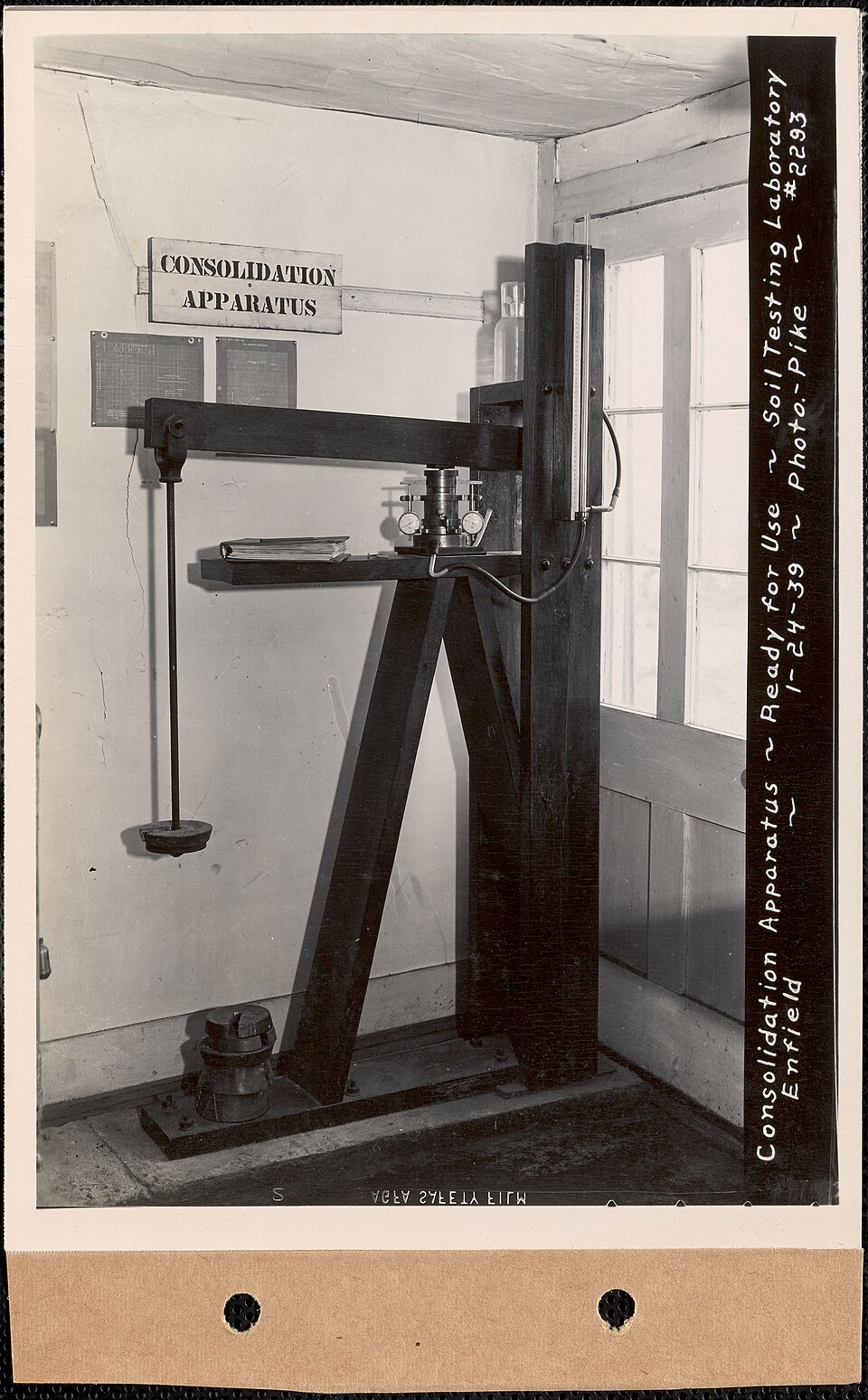
Saturated clays settle slowly over time as excess pore water pressure built up under a new load gradually dissipates and squeezes water out of the clay's pore structure — a process called consolidation. The dimensionless time factor Tv is the key parameter that links real elapsed time to the percentage of that settlement that has actually occurred, via consolidation charts or the analytical Terzaghi solution. Because Tv depends on the square of the drainage path length, doubling the thickness of a clay layer (or halving the number of drainage faces) quadruples the time needed to reach the same degree of consolidation — a critical consideration when deciding whether to use vertical drains to accelerate settlement on a construction schedule.
The consolidation time factor is Tv = Cv*t/Hdr^2. where C_v is the coefficient of consolidation, t_cons is elapsed time, and H_dr is the longest drainage path length within the clay layer.
Inputs
C_v := 2.5 m^2/yr=7.92e-08 m^2/s
t_cons := 3 yr=9.47e+07 s
H_dr := 4 m=4 m
Time factor nondimensionalizes elapsed time by how fast water can diffuse out of the clay (Cv) relative to how far it has to travel (Hdr squared), which is what lets consolidation charts be used for any project scale.
T_v := C_v·t_cons/H_dr^2=0.47
Results
A time factor of roughly 0.4-0.5 corresponds to something on the order of 60-70% average degree of consolidation on the standard Tv chart, meaning meaningful settlement has occurred but is not yet complete after 3 years. Because Hdr enters squared in the denominator, halving the drainage path (for instance, by installing a drainage blanket at mid-depth or wick drains) cuts the time to reach a given Tv by a factor of four — the standard justification for prefabricated vertical drains on tight schedules.
Assumptions & limitations
- One-dimensional (vertical) consolidation assumed, per Terzaghi theory.
- Coefficient of consolidation Cv assumed constant over the stress range.
- Hdr is the longest drainage path — halved if double drainage (top and bottom) is available.
- Time factor must still be converted to degree of consolidation via chart/series solution.