Cooling Load from Window Solar Gain
Cooling Load from Window Solar Gain
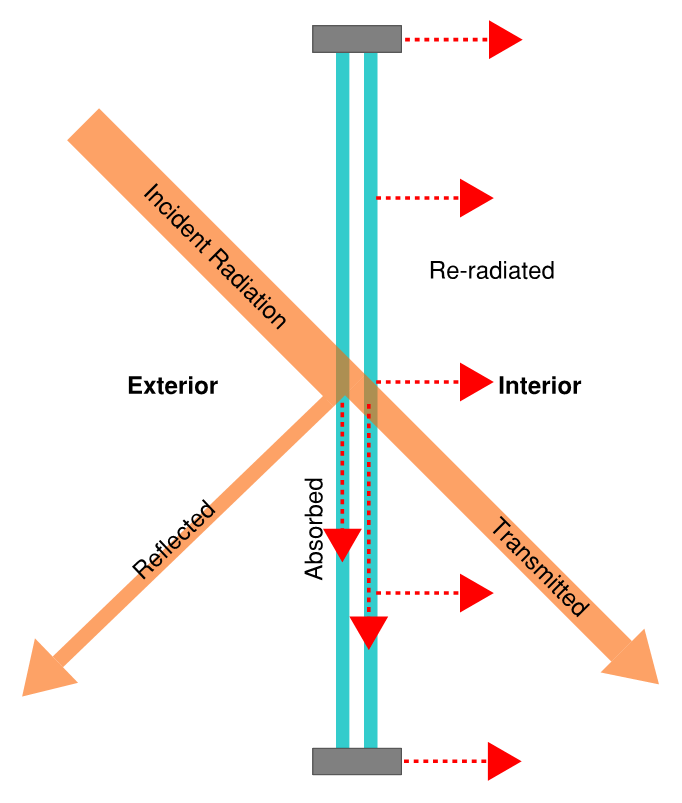
Solar radiation streaming through glazing is one of the largest and most variable components of a building's cooling load, and HVAC designers estimate it using the solar heat gain coefficient (SHGC), a single number rating how much of the incident solar radiation a particular window assembly lets through as heat gain into the space. Because SHGC can range from under 0.25 for high-performance low-emissivity coated glass to over 0.8 for clear single glazing, window selection alone can swing a building's peak cooling load by a large margin — which is why glazing specification is one of the first levers pulled in both cooling load reduction and energy code compliance.
The solar cooling load is Q = A·SHGC·I, the window area times its solar heat gain coefficient times the incident solar irradiance. where A is the window area, SHGC is the window's solar heat gain coefficient (dimensionless), and I is the incident solar irradiance on the window.
Inputs
A_win := 20 m^2=20 m^2
SHGC_g := 0.4=0.4
I_sol := 700 W/m^2=700 kg/s^3
Multiplying the window area by its SHGC and the incident solar intensity gives the rate at which solar energy enters the space through that window as a cooling load the HVAC system must remove.
Q_solar := A_win·SHGC_g·I_sol=5600 W
Results
A solar gain of 5.6 kW through a single 20 m² window is a substantial load — comparable to several residential air conditioning tons — and illustrates why large glazed facades drive cooling equipment sizing even when internal loads (people, lights, equipment) are modest. This load varies through the day and year as the sun angle and irradiance change, so a full cooling load calculation would evaluate it at the peak design hour rather than using a single fixed irradiance value; shading devices, overhangs, or a lower-SHGC glazing product are the standard ways to reduce this term when it dominates the load.
Assumptions & limitations
- Direct transmission only — ignores reradiation from indoor surfaces and time-lag (thermal mass) effects.
- SHGC treated as constant regardless of solar incidence angle.
- No shading (overhangs, blinds, adjacent buildings) accounted for.
- Steady-state instantaneous load, not an integrated daily or peak-design-day value.