Coulomb Active Earth Pressure Coefficient
Coulomb Active Earth Pressure Coefficient
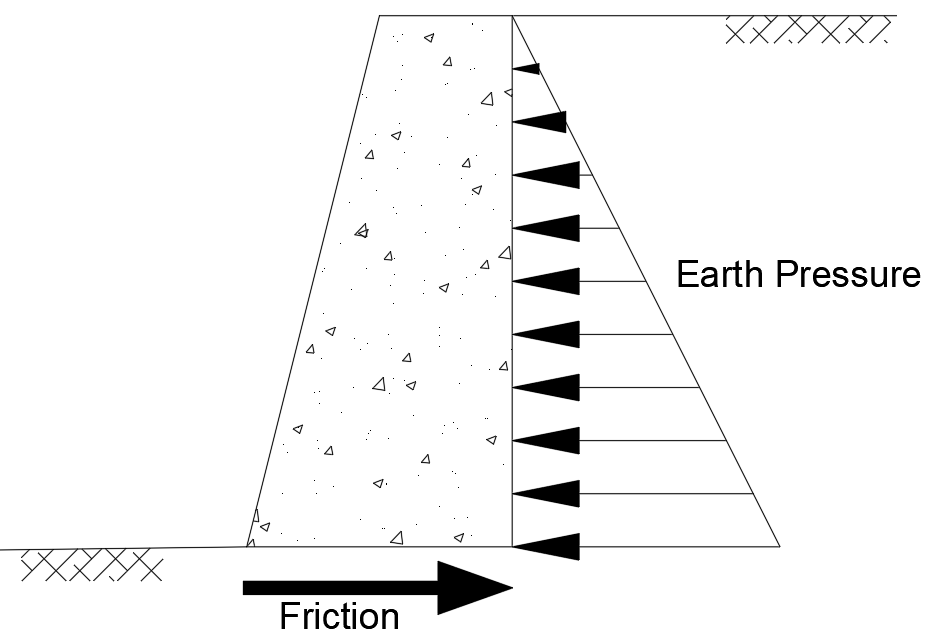
Every retaining wall must be designed to resist the lateral pressure the soil behind it exerts as it tries to push the wall outward. The active earth pressure coefficient converts vertical soil stress into the horizontal pressure the wall actually feels once the soil has been allowed to relax slightly and mobilize its full shear strength — the minimum pressure condition. Because lateral pressure directly drives wall thickness, reinforcement, and footing size, even a modest error in the assumed friction angle propagates directly into Ka (through a squared tangent) and from there into every subsequent wall design calculation.
The Coulomb active pressure coefficient (vertical wall, horizontal backfill, no wall friction) is Ka = tan^2(pi/4 - phi/2). where phi_a is the soil's internal friction angle, in radians.
Inputs
phi_a := 0.5236=0.52
As the friction angle increases, the soil can hold itself up more and pushes less on the wall, which is why Ka decreases as phi grows.
K_a := tan(pi/4 - phi_a/2)^2=0.33
Results
A friction angle of 30 degrees gives an active coefficient of about 0.33, a very typical value for design sands and gravels, meaning the horizontal pressure on the wall is roughly a third of the vertical soil stress at the same depth. Retaining walls are then sized using this coefficient together with soil unit weight and wall height to get the total lateral thrust — an unusually low phi (soft or loose soil) sharply raises Ka and the resulting wall demand.
Assumptions & limitations
- Vertical wall back and horizontal backfill surface assumed.
- No wall friction (smooth wall-soil interface) considered.
- Cohesionless soil — cohesion c is not included in this coefficient.
- Active condition requires the wall to yield/deflect slightly to mobilize full soil strength.