Evaporative Cooler Outlet Temperature
Evaporative Cooler Outlet Temperature
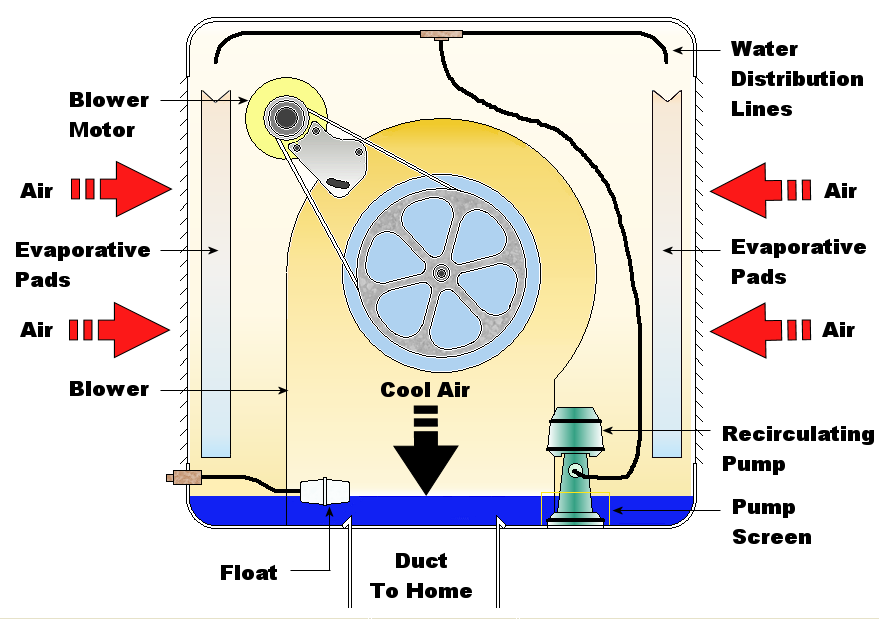
Direct evaporative ("swamp") coolers lower air temperature by evaporating water directly into the airstream, which absorbs latent heat from the air and drops its dry-bulb temperature — an effect that is highly effective in hot, dry climates but nearly useless in humid ones, since the achievable cooling depends on how far apart the wet-bulb and dry-bulb temperatures already are. Cooler effectiveness (typically 0.7–0.9 for a well-maintained pad) describes how close the outlet air gets to the theoretical limit — the inlet wet-bulb temperature — and is the key performance number manufacturers publish and HVAC designers use to predict actual delivered cooling in a given climate.
The outlet temperature is Tout = Tdb - eff·(Tdb - Twb), where eff is the cooler effectiveness. where Tdb is the inlet dry-bulb temperature, Twb is the inlet wet-bulb temperature, and eff is the evaporative cooler effectiveness (temperatures in kelvin).
Inputs
T_db := 308 K=308 K
T_wb := 295 K=295 K
eff_evap := 0.75=0.75
Subtracting the effectiveness-weighted gap between dry-bulb and wet-bulb temperature from the inlet dry-bulb temperature gives how far the outlet air temperature actually drops toward the wet-bulb limit.
T_out2 := T_db - eff_evap·(T_db - T_wb)=298.25 K
Results
The outlet air cools from 308 K (about 35°C) to roughly 298.25 K (about 25.1°C), a meaningful ~10°C drop achieved with no mechanical refrigeration, which is why evaporative cooling is so attractive in hot, dry climates. The result can never go below the inlet wet-bulb temperature no matter how good the pad media is (that is the eff = 1.0 limit), so in humid climates where Tdb and Twb are already close together, evaporative cooling simply cannot deliver much temperature drop regardless of equipment quality — a mechanical air conditioner would be needed instead.
Assumptions & limitations
- Direct evaporative cooling only (no indirect/secondary air path).
- Constant effectiveness assumed regardless of airflow rate.
- Adequate water supply to the pad media assumed (no dry spots).
- Ignores the added moisture load in the supply air, only tracks dry-bulb temperature.