Pile Group Efficiency (Converse-Labarre)
Pile Group Efficiency (Converse-Labarre)
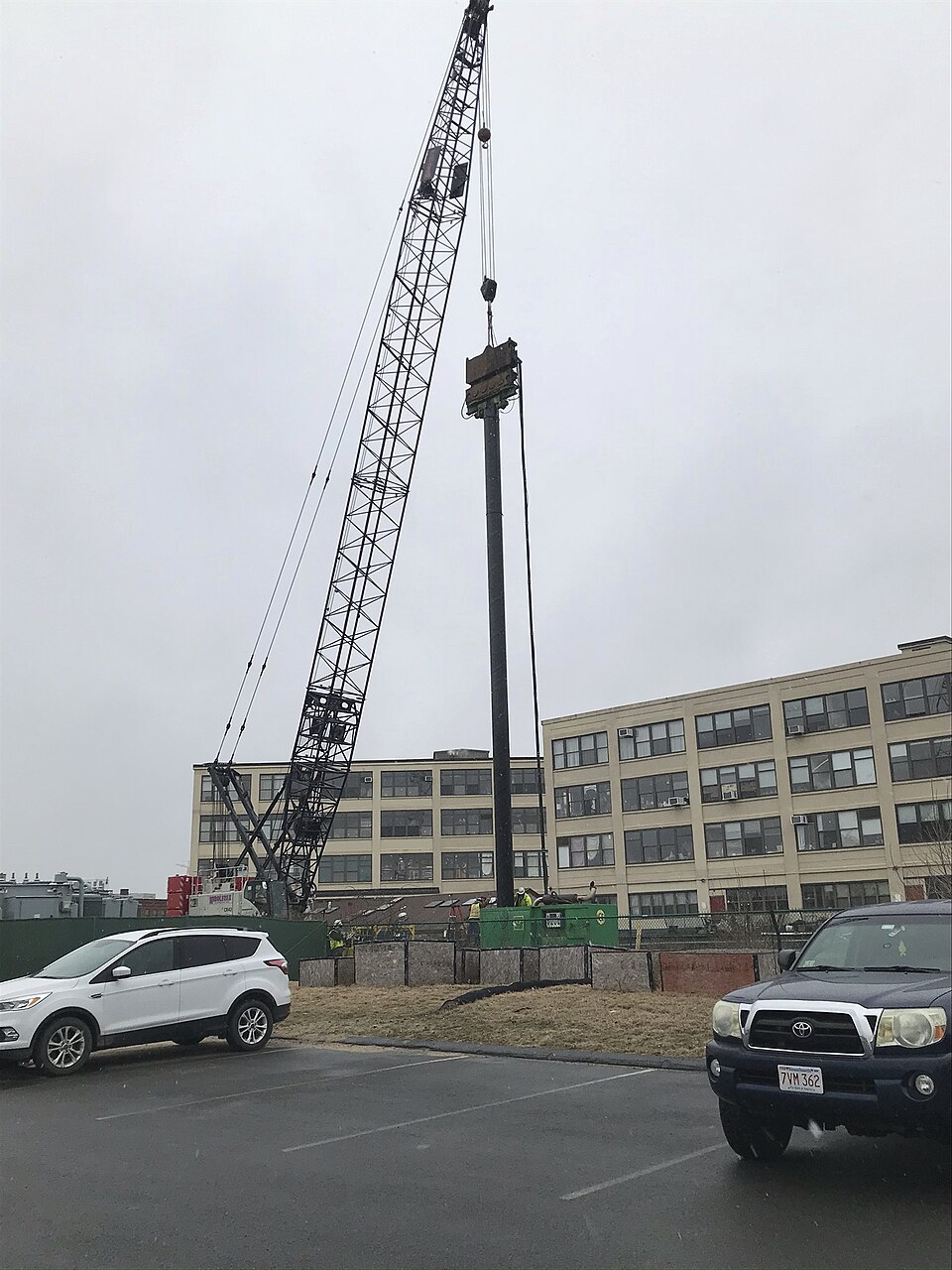
Piles are almost never used singly — they are driven in groups beneath a pile cap to share a column or wall load. But once piles are close enough together, their zones of soil stress overlap, so the group's total capacity is somewhat less than the sum of each pile's individual capacity computed in isolation. The Converse-Labarre formula is the traditional empirical way to estimate this group efficiency from pile spacing, diameter, and the number of rows and columns in the group; spacing piles too closely to save space can silently erode group capacity well below what a single-pile calculation would suggest.
Group efficiency is Eg = 1 - theta*((n1-1)*n2 + (n2-1)*n1)/((pi/2)*n1*n2), with the interaction angle theta = atan(d/s). where d_sp is the pile diameter, s_sp is the center-to-center pile spacing, and n_1 and n_2 are the number of piles in each direction of the rectangular grid.
Inputs
d_sp := 0.4 m=400 mm
s_sp := 1.2 m=1.2 m
n_1 := 3=3
n_2 := 4=4
The interaction angle theta measures how much of the angle subtended between adjacent piles is "occupied" by pile diameter versus open spacing; it must be computed in radians here since the group efficiency formula below uses pi/2 rather than 90 degrees.
theta_cl := atan(d_sp/s_sp)=0.32 rad
This combines theta with the pile counts in each direction to estimate how much overlap reduces the group's average per-pile efficiency relative to isolated piles.
E_g := 1 - theta_cl·((n_1-1)·n_2 + (n_2-1)·n_1)/((pi/2)·n_1·n_2)=0.71
Results
An efficiency in the 0.7-0.9 range is typical for this spacing-to-diameter ratio, meaning the group's effective per-pile capacity is discounted by 10-30% relative to a single isolated pile. Widening the spacing ratio (larger s relative to d) quickly pushes efficiency back toward 1.0, which is why minimum pile spacing rules (often 2.5-3 pile diameters) exist in most foundation codes.
Assumptions & limitations
- Rectangular pile grid with uniform spacing in both directions.
- Converse-Labarre is an empirical approximation, not a rigorous elastic solution.
- Applies to friction piles; end-bearing-dominated groups may behave differently.
- Assumes theta is computed in radians (uses pi/2, not 90 degrees) throughout.