Psychrometric Humidity Ratio
Psychrometric Humidity Ratio
HVAC engineers describe how much moisture air is holding using the humidity ratio — kilograms of water vapor per kilogram of dry air — because unlike relative humidity it does not change as air is heated or cooled without adding or removing moisture, making it the natural quantity to track through a duct or air handler. The humidity ratio follows directly from the partial pressure the water vapor exerts relative to the total atmospheric pressure, scaled by the ratio of water's to dry air's molar mass (the famous 0.622 constant), and it is the foundation every other psychrometric chart quantity (dew point, wet-bulb temperature, enthalpy) is built from.
The humidity ratio is W = 0.622·Pv/(P - Pv), where Pv is the water vapor partial pressure and P is the total atmospheric pressure. where Pv is the partial pressure of water vapor in the air and P is the total (barometric) atmospheric pressure.
Inputs
P_v := 1.5 kPa=1500 Pa
P_atm := 101.325 kPa=101325 Pa
Scaling the ratio of vapor pressure to the remaining (dry air) pressure by the molar mass ratio of water to air converts a pressure ratio into a mass ratio — the humidity ratio used throughout HVAC design.
W_hum := 0.622·P_v/(P_atm - P_v)=9.35e-03
Results
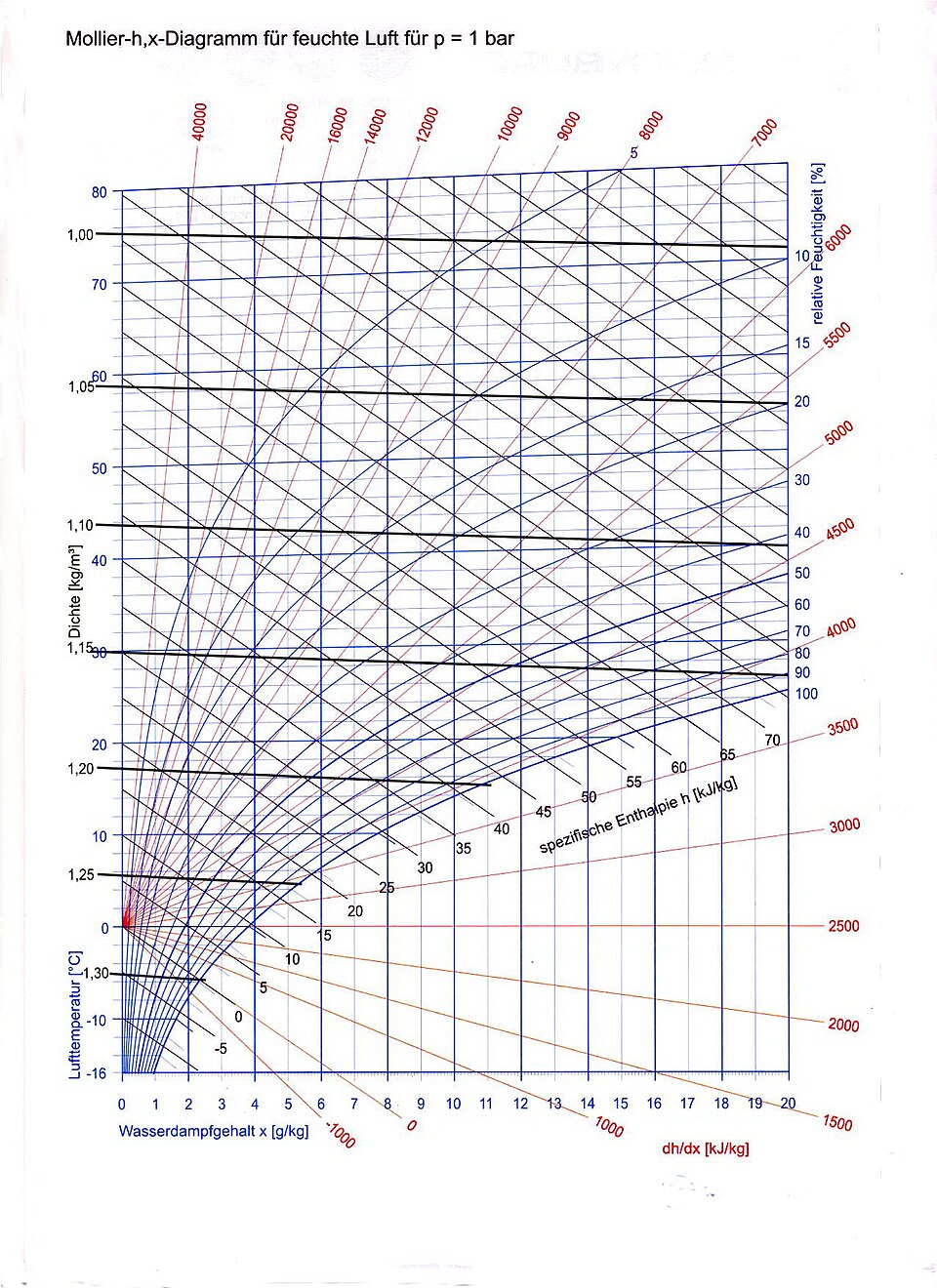
A humidity ratio around 0.0093 kg water per kg dry air (about 9.3 grams per kilogram) corresponds to moderately humid air, and this is the value that would be plotted on a psychrometric chart against dry-bulb temperature to find relative humidity, wet-bulb temperature, and enthalpy in one look-up. Because W depends only on vapor pressure and total pressure, it stays constant through a sensible-heating or sensible-cooling process (like a heating coil) and only changes when moisture is actually added or removed — which is exactly why HVAC engineers use it, rather than relative humidity, to track moisture through an air handling system.
Assumptions & limitations
- Moist air treated as an ideal gas mixture.
- Total pressure P assumed constant (near sea-level atmospheric).
- Water vapor partial pressure Pv assumed already known or measured.
- No condensation occurring at the evaluated state (unsaturated air).