Quadratic Formula Roots
Roots of a Quadratic Equation
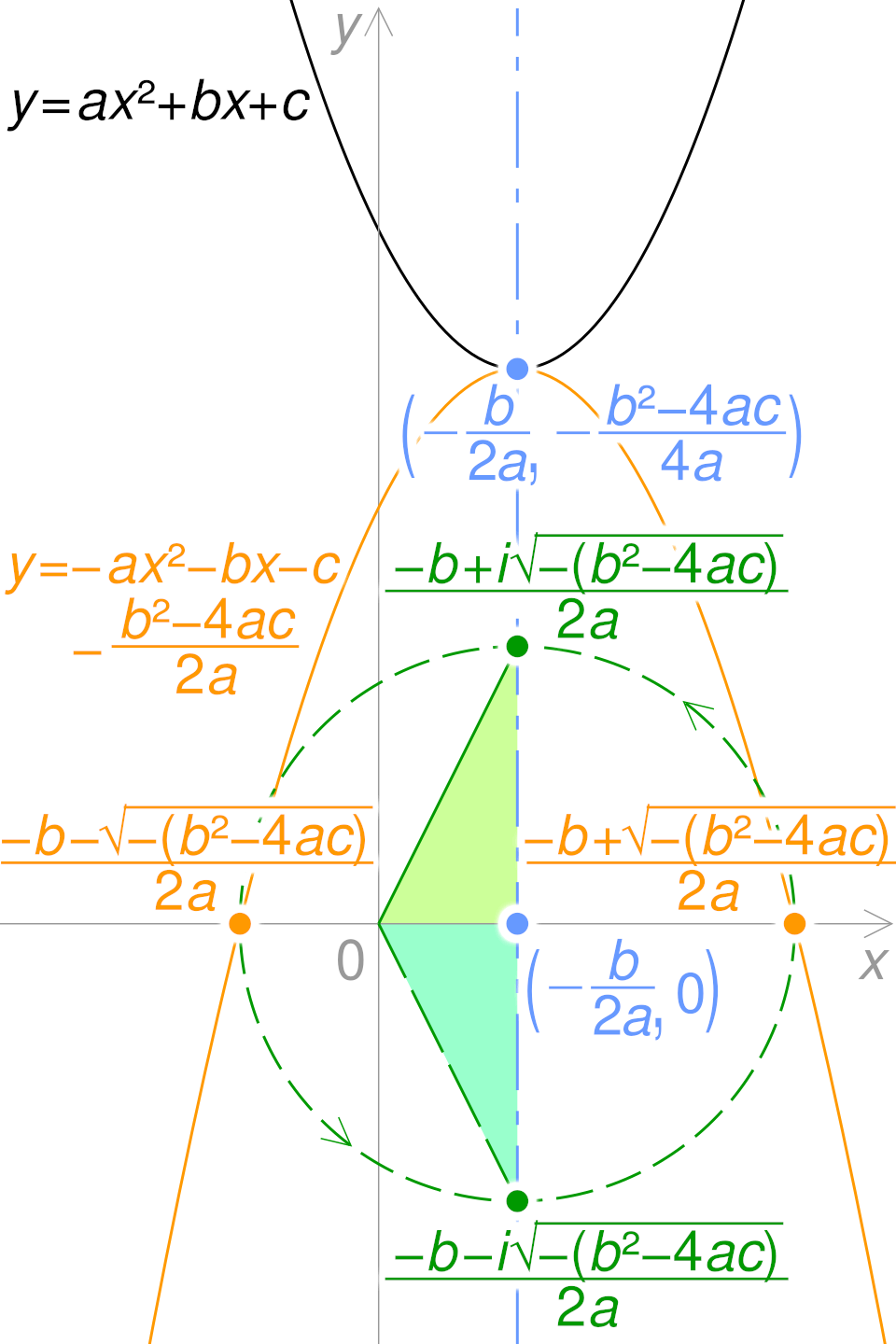
The quadratic formula solves any equation of the form ax² + bx + c = 0. This worksheet evaluates the discriminant (which tells you how many real roots exist) and both roots.
The roots are x = (−b ± √(b² − 4ac))/(2a), and the discriminant is Δ = b² − 4ac.
Inputs
The three coefficients of ax² + bx + c.
a := 2=2
b := -7=-7
c := 3=3
Discriminant
A positive discriminant gives two distinct real roots, zero gives one repeated root, and a negative value gives a complex-conjugate pair.
disc := b^2 - 4·a·c=25
Roots
x_1 := (-b + sqrt(disc))/(2·a)=3
x_2 := (-b - sqrt(disc))/(2·a)=0.5
Results
The two roots are where the parabola crosses the x-axis. Their sum equals −b/a and their product c/a — a quick sanity check (here, sum 3.5 and product 1.5). The quadratic formula underpins everything from projectile times to control-system poles.
Assumptions & limitations
- Coefficient a must be non-zero (otherwise it is linear).
- This sheet shows the real roots; a negative discriminant indicates complex roots.