Straight Rectangular Fin Heat Transfer Rate
Straight Rectangular Fin Heat Transfer Rate
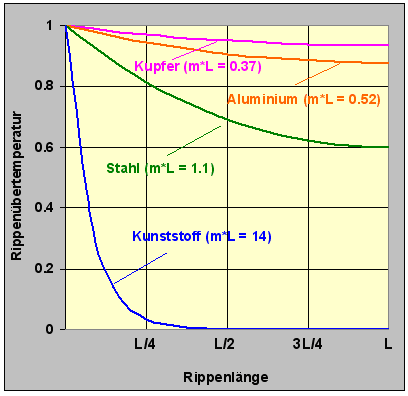
Fins extend heat transfer surfaces — think heat sink fins on a CPU cooler or the cooling fins on an engine cylinder — by adding surface area for convection to act on, but a fin only works if heat can actually conduct efficiently from its base to its tip; the classic fin equation captures this trade-off between conduction along the fin and convection off its surface in a single closed-form heat rate. The fin parameter m, and the hyperbolic tangent term it feeds into, describe how "fin-efficient" the geometry is: short, highly conductive fins act almost isothermal end-to-end (tanh term near mL), while long, poorly conductive fins lose most of their temperature advantage before reaching the tip and add little extra heat transfer for their added material cost.
The fin heat rate is Q = sqrt(h·P·k·Ac)·theta_b·tanh(m·L), where m = sqrt(h·P/(k·Ac)) is the fin parameter. where h is the convective heat transfer coefficient, P is the fin perimeter, k is the fin material's thermal conductivity, Ac is the fin cross-sectional area, theta_b is the base-to-ambient temperature difference, and L is the fin length.
Inputs
h_fin := 25 W/(m^2·K)=25 kg/K/s^3
P_fin := 0.04 m=40 mm
k_fin := 200 W/(m·K)=200 kg·m/K/s^3
Ac_fin := 0.0001 m^2=1e-04 m^2
theta_b := 40 K=40 K
L_fin := 0.05 m=50 mm
The fin parameter m measures how quickly the fin's excess temperature decays along its length, set by the balance between how easily heat is lost from the surface (h, P) and how easily it is conducted along the fin (k, Ac).
m_fin := sqrt(h_fin·P_fin/(k_fin·Ac_fin))=7.07 1/m
Combining the fin parameter with the base temperature difference through the hyperbolic tangent gives the total heat transfer rate the fin delivers, accounting for the temperature drop along its length rather than assuming it stays at the base temperature throughout.
Q_fin := sqrt(h_fin·P_fin·k_fin·Ac_fin)·theta_b·tanh(m_fin·L_fin)=1.92 W
Results
A heat rate on the order of a few watts from a single small fin is typical, and multiplying by the number of fins in an array gives the total heat sink capacity. The product mL is worth checking separately: values well below 1 mean the fin is not using its full length effectively (it stays nearly isothermal, so adding more length would help), while values above about 2–3 mean the tip has already cooled close to ambient and extra length adds little more heat transfer for the added material and pressure-drop cost. This is exactly the trade-off heat sink designers balance when choosing fin spacing, thickness, and length.
Assumptions & limitations
- Steady-state, one-dimensional conduction along the fin axis.
- Convective coefficient h uniform over the entire fin surface.
- Adiabatic fin tip assumed (no significant heat loss from the tip itself).
- Constant material properties, no radiation heat transfer included.