Three-Phase Transformer Apparent Power (kVA)
Three-Phase Transformer Apparent Power (kVA)
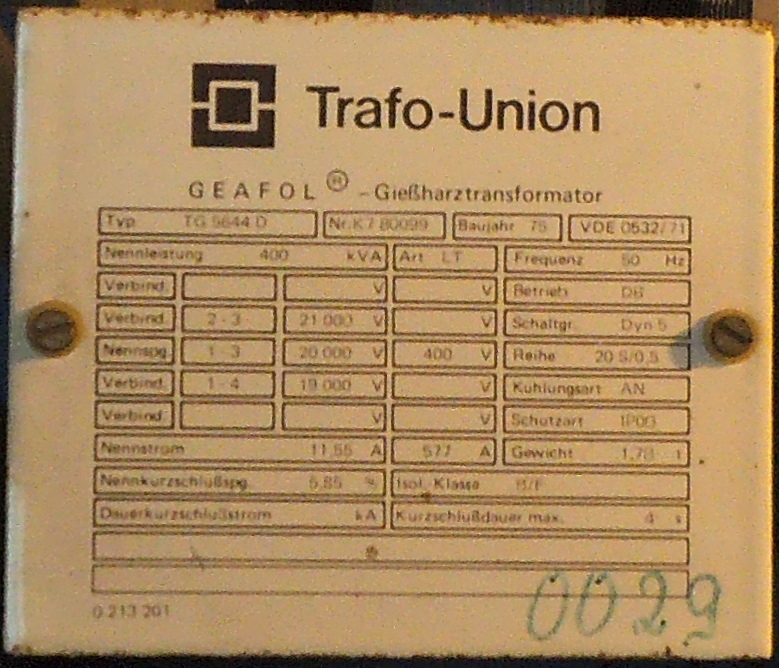
A three-phase transformer’s apparent power rating (in kVA) combines the line-to-line voltage and line current across all three phases, with a factor of √3 arising from the geometry of a balanced three-phase system. This kVA figure is the number found directly on a transformer’s nameplate.Knowing how to compute or check this figure from measured voltage and current lets an engineer verify a transformer is not being pushed beyond its rating, or size a replacement unit correctly for an expected line current at a known system voltage.
The three-phase apparent power is S = √3·V_LL·I_line, the line-to-line voltage times the line current times the square root of three. where V_LL is the line-to-line voltage and I_line is the line current.
Inputs
V_ll := 11 kV=11000 V
I_line := 50 A=50 A
The √3 factor accounts for the phase relationship between the three balanced phases, converting per-phase quantities into the total three-phase apparent power.
S_kva := sqrt(3)·V_ll·I_line=952627.94 W
Results
A result of roughly 950 kVA is a realistic rating for a medium-size distribution transformer serving an 11 kV feeder at 50 A. Real load current should stay comfortably below the value that would drive S up to the transformer’s nameplate kVA rating, since operating consistently near or above it shortens transformer life through accelerated insulation aging.
Assumptions & limitations
- Balanced three-phase system assumed.
- Apparent power (kVA), not real power — power factor not applied.
- Voltage and current assumed to be steady-state RMS values.