Vapor-Compression Refrigeration COP
Vapor-Compression Refrigeration COP
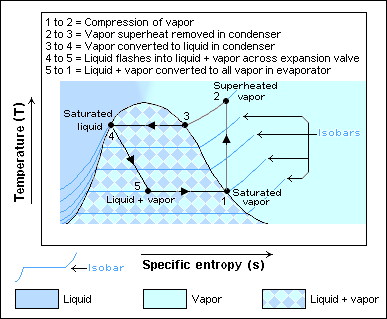
Vapor-compression refrigeration runs behind nearly every refrigerator, air conditioner, and chiller, moving heat from a cold space to a warmer one by compressing, condensing, expanding, and evaporating a refrigerant, and its coefficient of performance (COP) — cooling delivered per unit of compressor work — is the headline efficiency metric used to compare units and estimate operating cost. Because COP for refrigeration is a ratio of two things you actually pay for and get (electricity in, cooling out), it maps directly onto utility bills; a COP of 3 means three units of free cooling for every unit of paid electrical energy, which is why COP, not raw cooling capacity, is what "high-efficiency" labels on air conditioners are really certifying.
The coefficient of performance is COP = Qevap/Wcomp, the refrigeration (cooling) effect divided by the compressor work input. where Qevap is the rate of heat absorbed in the evaporator (cooling delivered) and Wcomp is the compressor power input.
Inputs
Q_evap := 8 kW=8000 W
W_comp := 2 kW=2000 W
Dividing the cooling effect by the electrical work spent to produce it gives the coefficient of performance — how many units of cooling are obtained per unit of paid-for energy.
COP_ref := Q_evap/W_comp=4
Results
A COP of 4 is a solid, realistic value for a well-matched vapor-compression air-conditioning or refrigeration system operating at moderate temperature lift; typical residential units land in the range of about 2.5 to 5 depending on the temperature difference between the cold and hot sides. A COP dropping much below about 2 usually points to a large temperature lift (very cold evaporator or very hot condenser), a dirty condenser coil, or a low refrigerant charge, all of which are the first things a technician checks. COP always trades off against temperature lift, so a freezer necessarily runs a lower COP than a comfort air conditioner even with identical equipment quality.
Assumptions & limitations
- Steady-state cycle operation, not a transient startup/defrost condition.
- Compressor work here represents actual (not ideal isentropic) shaft work.
- Refrigerant-side losses (subcooling, superheat control) not separately modeled.
- Does not include auxiliary power (fans, pumps) sometimes included in a system-level COP.