Absorption Column Packing Height (HTU–NTU)
Absorption Column Packing Height (HTU–NTU)
Packed absorption columns remove a soluble gas — carbon dioxide, hydrogen sulfide, ammonia — from a gas stream by contacting it with a liquid solvent flowing down over packing material, and the central design question is simply "how tall does the packed bed need to be?" The classic HTU–NTU method answers this by splitting the problem into a mass-transfer-rate term (height of a transfer unit, HTU) and a driving-force term (number of transfer units, NTU) that are multiplied together to get the total height, separating equipment performance from the difficulty of the separation itself.
The required packing height is Z = HTU·NTU, the height of a transfer unit times the number of transfer units. where HTU is the height of packing equivalent to one transfer unit (a property of the packing and flow conditions) and NTU is the number of transfer units needed for the required removal.
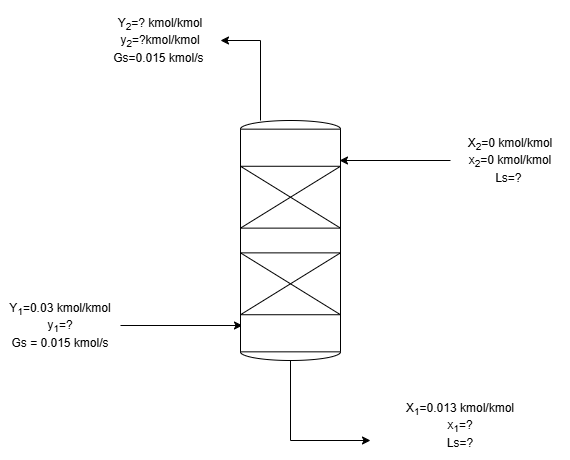
Inputs
HTU_pack := 0.6 m=600 mm
NTU_pack := 4.5=4.5
Multiplying the height each transfer unit takes up by how many transfer units the separation requires gives the total packed bed height needed.
Z_pack := HTU_pack·NTU_pack=2.7 m
Results
A packing height of 2.7 m is a realistic size for an industrial gas absorber handling a moderately difficult separation, and it converts directly into vessel cost and plot space. Because Z scales linearly with NTU, chasing a much higher removal efficiency (larger NTU) makes the column disproportionately taller and more expensive, which is why absorber specs are usually set at the minimum removal that meets emissions or process limits rather than the maximum achievable. If HTU can be reduced with better packing (more surface area, better liquid distribution), the same NTU can be achieved in a shorter, cheaper column.
Assumptions & limitations
- HTU treated as constant over the full column height.
- Dilute system with a roughly linear equilibrium (Henry's law) relationship.
- Countercurrent flow with good liquid and gas distribution across the packing.
- No channeling or flooding within the packed section.