Beat Frequency of Two Close Tones
Beat Frequency of Two Close Tones
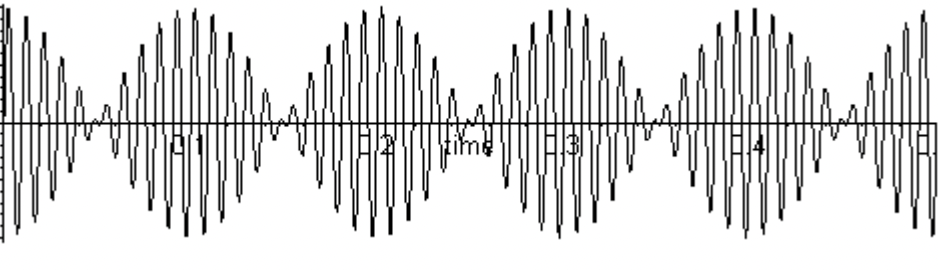
When two tones very close in pitch play simultaneously, the ear hears a periodic swelling and fading of loudness called beating, at a rate equal to the difference between the two frequencies. Musicians use this effect directly — piano tuners and guitarists listen for beats to slow down and stop as two strings or notes are brought into tune.The same beating phenomenon shows up outside music too: it explains the throbbing sound of two out-of-sync engines or propellers, and is used deliberately in some measurement instruments (like beat-frequency oscillators) to detect very small frequency differences that would otherwise be imperceptible.
The beat frequency is f_beat = |f_1 − f_2|. where f_1t and f_2t are the two tone frequencies and f_beat is the resulting audible beat frequency.
Inputs
f_1t := 440 Hz=440 Hz
f_2t := 446 Hz=446 Hz
Take the absolute difference between the two frequencies — the sign does not matter, only the size of the mismatch, which sets how fast the loudness pulses.
f_beat := abs(f_1t - f_2t)=6 Hz
Results
A 6 Hz beat frequency is easily heard as a slow, distinct throbbing — roughly six pulses of loudness per second — which is exactly the kind of mismatch a tuner would still want to correct. As the two tones are brought closer together the beats slow down further, disappearing entirely (zero beat frequency) once the tones match exactly.
Assumptions & limitations
- Both tones have similar amplitude (beats are most audible when the two loudnesses are comparable).
- Frequency difference is small compared to either tone (a few Hz to a few tens of Hz, within audible beating range).
- Steady, continuous tones (not short transient sounds).