Composite Laminate Modulus (Rule of Mixtures)
Composite Laminate Modulus (Rule of Mixtures)
Fiber-reinforced composites derive their stiffness from load sharing between a stiff, strong fiber phase and a more compliant matrix that binds the fibers together and transfers load between them. The rule of mixtures is the simplest and most widely used model for predicting the resulting longitudinal (fiber-direction) modulus of the laminate. This iso-strain assumption works well when loading is aligned with the fibers, but it significantly overestimates stiffness in the transverse direction, where a different (iso-stress) rule of mixtures applies instead — using the longitudinal formula for a transverse or off-axis load case is a common composite design mistake.
The rule-of-mixtures longitudinal modulus is Ec = Ef*Vf + Em*(1-Vf). where E_f is the fiber modulus, V_f is the fiber volume fraction, and E_m is the matrix modulus.
Inputs
E_f := 230 GPa=230000 MPa
V_f := 0.6=0.6
E_m := 3.5 GPa=3500 MPa
Because fiber and matrix are assumed to stretch by the same amount (iso-strain) under longitudinal load, each phase's contribution to stiffness is simply weighted by how much volume it occupies.
E_c := E_f·V_f + E_m·(1-V_f)=139400 MPa
Results
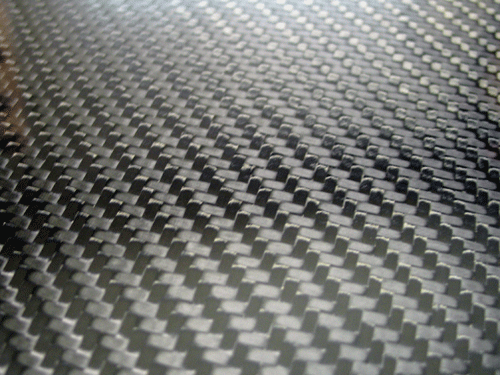
A composite modulus well over 100 GPa at 60% fiber volume fraction is typical for a carbon-fiber/epoxy laminate, showing how strongly the stiff fiber phase dominates the result even though the matrix occupies nearly half the volume. Because Ec scales almost linearly with Vf here, small manufacturing variations in fiber volume fraction — from resin-rich or resin-starved regions — directly translate into measurable stiffness variation across a part.
Assumptions & limitations
- Longitudinal (fiber-direction) loading only — transverse modulus uses a different (iso-stress) model.
- Perfect fiber-matrix bonding and no voids assumed.
- Unidirectional, continuous fibers aligned with the load direction.
- Linear elastic behavior of both constituent phases.