Control Valve Flow Coefficient (Kv, Metric)
Control Valve Flow Coefficient (Kv, Metric)
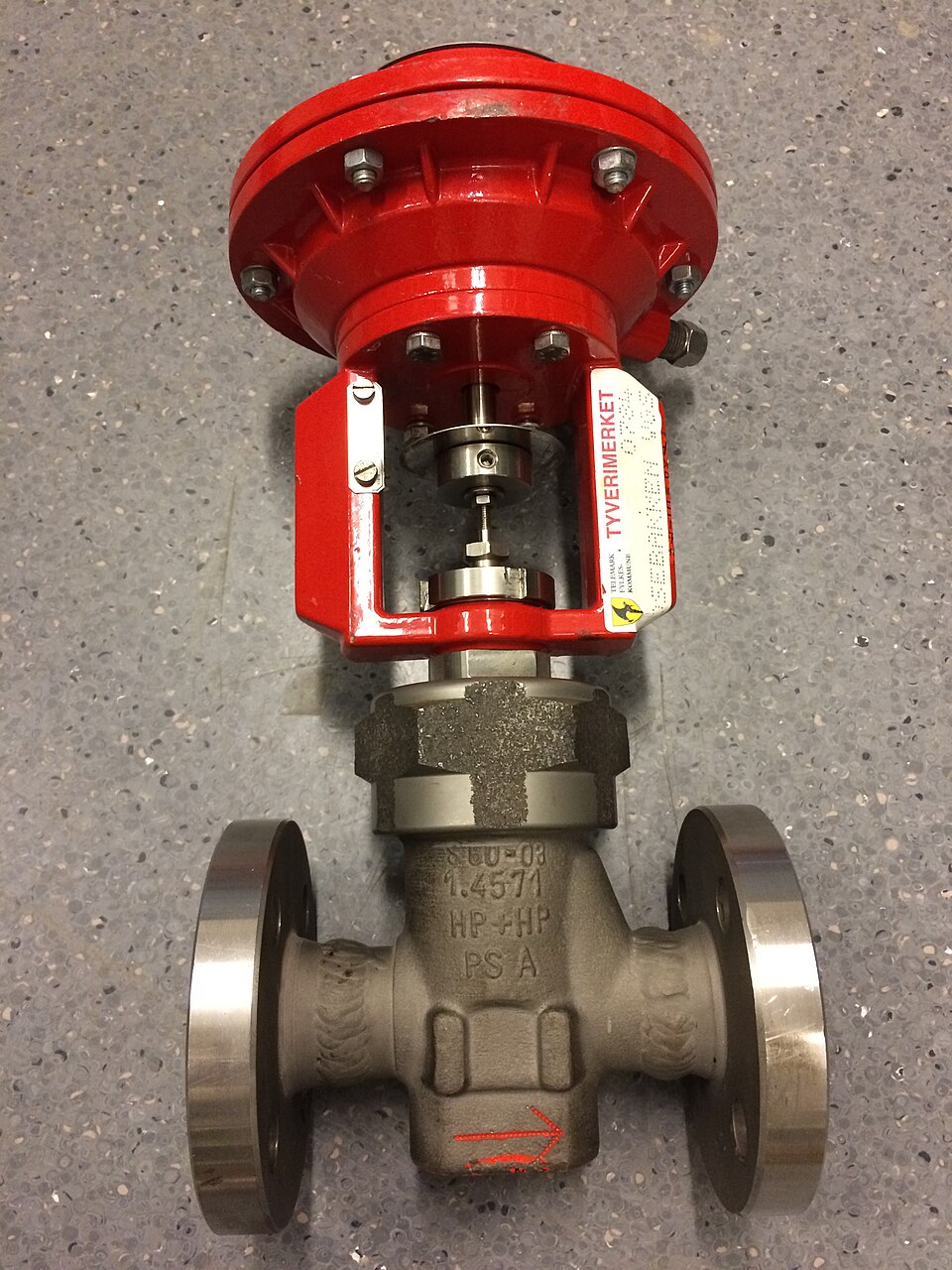
The flow coefficient is how control valves are sized and specified in practice: rather than describing a valve by its physical orifice geometry, manufacturers rate it by Kv (or the USCS equivalent Cv), a single empirical number relating flow rate through the valve to the pressure drop across it for a reference fluid, letting engineers select an off-the-shelf valve size directly from a required flow and pressure drop. Because Kv is defined and tabulated for water at reference conditions, converting a process flow rate and pressure drop into a required Kv is the standard first step in control valve selection, after which the calculated Kv is checked against a valve manufacturer's catalog to pick an appropriately sized trim.
The metric flow coefficient is Kv = Q·sqrt(SG/dP), the flow rate times the square root of specific gravity divided by pressure drop. where Q is the volumetric flow rate through the valve, SG is the fluid specific gravity relative to water, and dP is the pressure drop across the valve.
Inputs
Q_valve := 10 m^3/hr=2.78e-03 m^3/s
SG_fluid := 1.0=1
dP_valve := 2 bar=200000 Pa
Scaling the flow rate by the square root of specific gravity over pressure drop converts the actual process flow condition into the standardized Kv rating used to compare and select valves from a manufacturer's catalog.
Kv_valve := Q_valve·sqrt(SG_fluid/dP_valve)=6.21e-06 m^(7/2)/kg^(1/2)
Results
This worksheet's engine works internally in consistent SI base units, so it reports the result in an odd-looking compound unit rather than the industry-conventional m^3/(hr·bar^0.5) form — that display is not an error, just this tool's default unit bookkeeping. Converted to the conventional flow-coefficient convention (Q in m^3/hr, dP in bar), the same physical result is the familiar Kv ≈ 7.1 m^3/(hr·bar^0.5), which is the number that would actually be quoted on a valve manufacturer's data sheet and compared against a catalog to select a valve body and trim size, typically choosing a valve where the operating point falls in the middle of its travel range rather than nearly wide open or barely cracked, both of which give poor control resolution.
Assumptions & limitations
- Turbulent, non-cavitating, non-flashing liquid flow assumed (no compressible-flow correction).
- Kv defined at the valve's given travel/opening; a different opening gives a different Kv.
- Newtonian fluid with viscosity close enough to water that no viscosity correction is needed.
- Steady-state flow with the stated pressure drop measured directly across the valve only.