Critical Pressure Ratio at Sonic Flow (Compressible Flow Constant)
Critical Pressure Ratio at Sonic Flow (Compressible Flow Constant)
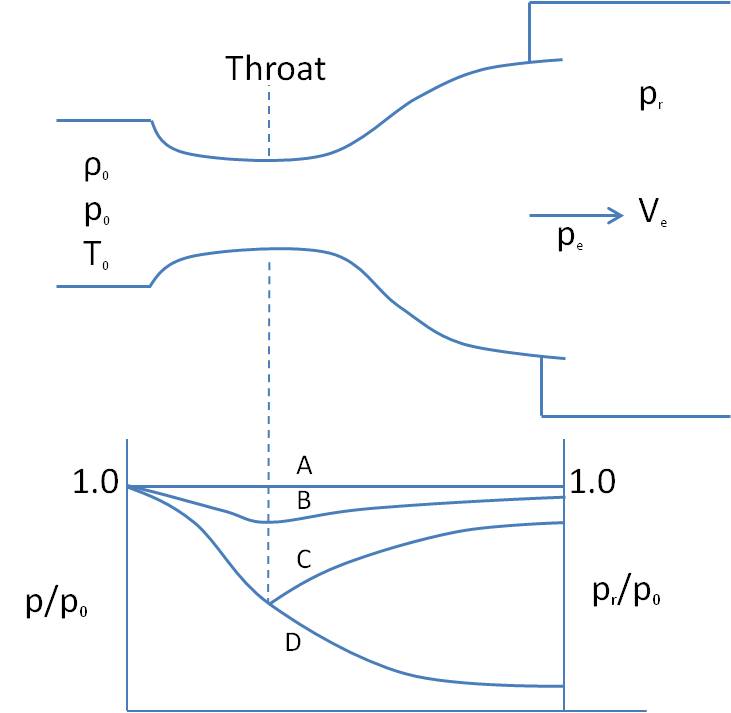
When gas flows through a converging nozzle from a high-pressure reservoir, the flow accelerates as the passage narrows, but there is a hard limit: once the throat reaches sonic velocity, further reducing downstream (back) pressure cannot accelerate the flow any further at the throat — a phenomenon called choked flow. The pressure ratio at which this first happens depends only on the gas's specific heat ratio. This critical pressure ratio is a foundational result in compressible flow, used throughout nozzle, valve, and safety-relief design: once the downstream-to-upstream pressure ratio drops below this critical value, the mass flow rate through the restriction becomes independent of downstream pressure and depends only on upstream stagnation conditions.
The critical pressure ratio is (P/P0)_crit = (2/(k+1))^(k/(k-1)). where k_crit is the gas's specific heat ratio (dimensionless).
Inputs
k_crit := 1.4=1.4
This ratio falls out purely from setting the local Mach number to 1 at the throat in the isentropic flow relations, and it depends only on the gas property k, not on the actual pressure or temperature levels involved.
P_ratio_crit := (2/(k_crit+1))^(k_crit/(k_crit-1))=0.53
Results
For air (k = 1.4) this ratio works out to about 0.528, meaning flow chokes once the downstream pressure drops below roughly 53% of the upstream stagnation pressure — a widely quoted benchmark number in compressible flow. Once flow is choked, increasing the pressure difference further does nothing to increase mass flow rate through the nozzle; only raising the upstream stagnation pressure (or enlarging the throat area) can increase it further, an important and sometimes counterintuitive fact for anyone sizing a relief valve or nozzle.
Assumptions & limitations
- Isentropic, one-dimensional flow assumed through the nozzle.
- Ideal gas with constant specific heat ratio k.
- Applies at the throat of a converging (or converging-diverging) nozzle at the choking condition.
- Result is dimensionless and depends only on k, not on the actual pressure/temperature values.