CSTR Reactor Residence Time
CSTR Reactor Residence Time
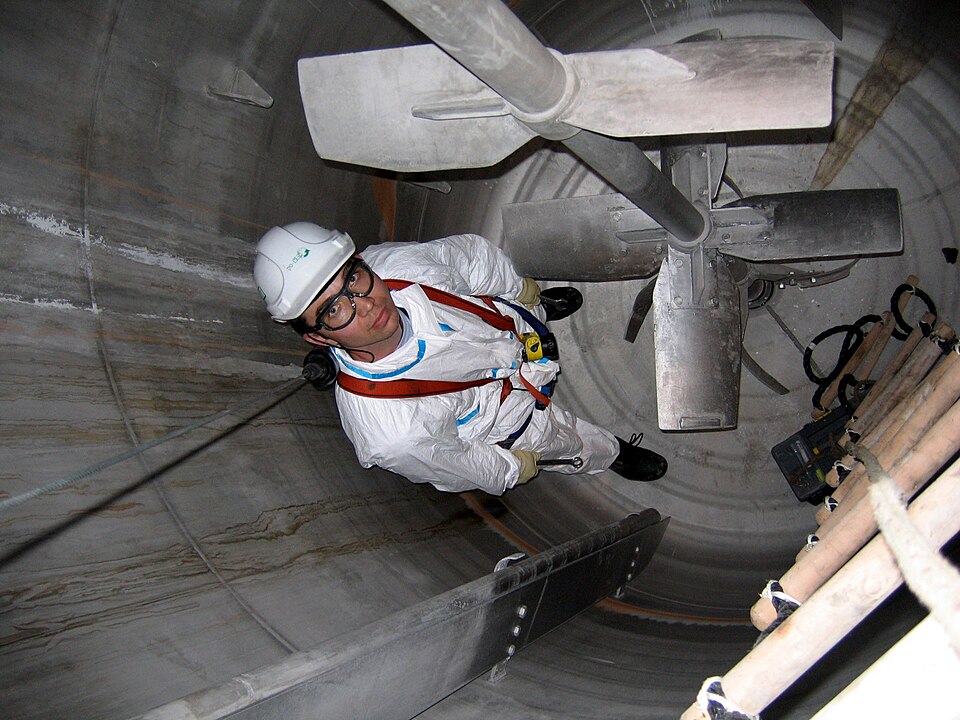
A continuous stirred-tank reactor (CSTR) is one of the workhorse reactor types in chemical processing — feed streams in, well-mixed reacting fluid inside, product stream out — and its single most important design variable is the residence time, how long, on average, a molecule of feed lingers in the tank before leaving. Residence time sets how much reaction can occur: too short and the reactants pass through barely converted, too long and the vessel is oversized and expensive, so this ratio of volume to flow rate is usually the very first number computed in any CSTR sizing problem.
The mean residence time is tau = V/Q, the reactor volume divided by the volumetric flow rate through it. where V is the reactor working volume and Q is the volumetric feed (and product) flow rate.
Inputs
V_r := 10 m^3=10 m^3
Q_r := 0.5 m^3/min=8.33e-03 m^3/s
Dividing the volume the fluid occupies by the rate fluid moves through it gives the average time any parcel of fluid spends reacting inside the tank.
tau_r := V_r/Q_r=1200 s
Results
A residence time of 20 minutes is a common order of magnitude for liquid-phase CSTRs running moderate-rate reactions, and it is the number that gets plugged directly into the conversion formula for whatever kinetics apply. If the required conversion is not reached at this tau, the usual fixes are to enlarge the vessel, add a second reactor in series, or find ways to speed the intrinsic reaction rate rather than simply increasing flow resistance. Because a CSTR is well mixed, some fluid elements leave almost immediately while others linger far longer than tau — it is only the average.
Assumptions & limitations
- Perfectly mixed, uniform composition throughout the vessel.
- Steady-state operation (constant V and Q).
- Single liquid phase, constant density.
- No dead zones or bypassing inside the reactor.