Culvert Discharge Capacity (Manning Conveyance)
Culvert Discharge Capacity (Manning Conveyance)
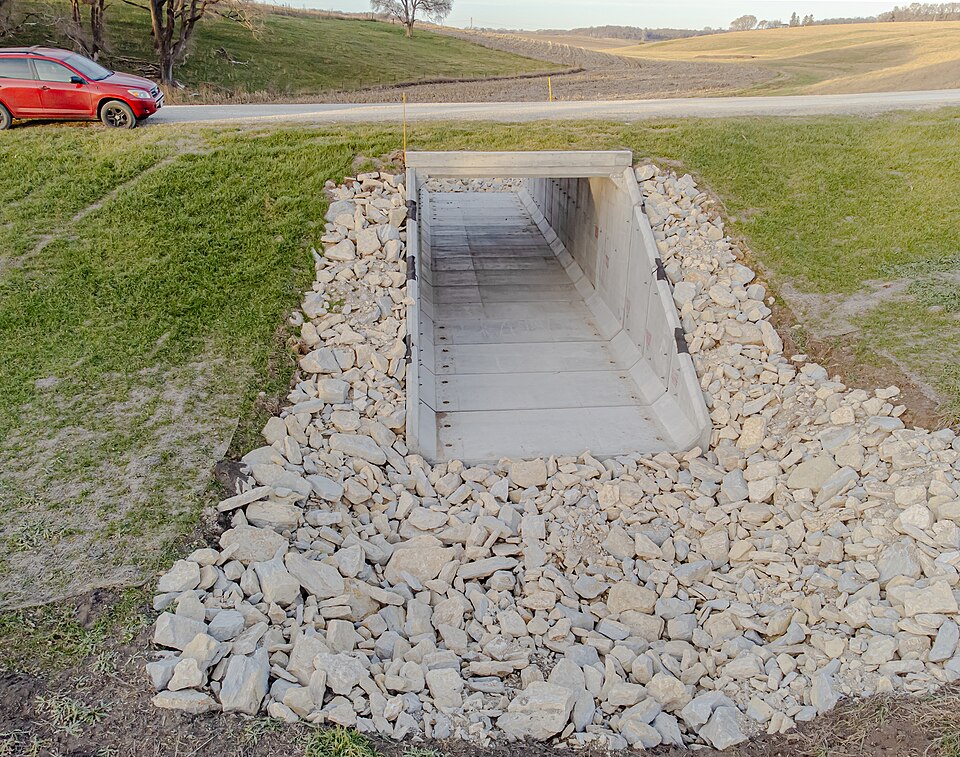
A culvert’s ability to pass storm flow under a roadway is governed by Manning’s equation, but rather than recompute roughness, area, and hydraulic radius by hand every time, hydraulic references bundle those into a single conveyance factor K = (1/n)·A·R^(2/3) that is tabulated for standard culvert sizes and shapes.Multiplying that conveyance factor by the square root of the channel slope gives the discharge directly — a fast check engineers use to confirm a culvert can pass the design storm without overtopping the road above it.
The discharge capacity is Q = K·√S, the conveyance factor times the square root of the channel slope. where K is the culvert’s hydraulic conveyance factor and S is the channel slope (dimensionless, rise over run).
Inputs
K_conv := 8 m^3/s=8 m^3/s
S_slope := 0.006=6e-03
Manning’s equation reduces to a simple product once the roughness, area and hydraulic radius are pre-combined into the conveyance factor.
Q_culv := K_conv·sqrt(S_slope)=0.62 m^3/s
Results
A discharge around 0.6 m³/s on a mild 0.6% slope is a modest flow for a mid-size culvert; because Q scales only with the square root of slope, steepening the culvert helps capacity much less than upsizing it would. If the design storm flow exceeds this Q, the fix is a larger culvert (bigger K), not just a steeper one.
Assumptions & limitations
- Steady, uniform (normal-depth) flow assumed.
- Conveyance factor K already embeds Manning’s roughness, area and hydraulic radius.
- Inlet control conditions (headwater ponding) are checked separately from this outlet-control estimate.