Distillation Column Reflux Ratio
Distillation Column Reflux Ratio
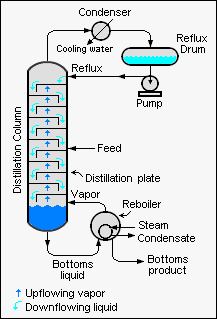
Distillation separates a liquid mixture by repeated vaporization and condensation up a column, and the reflux ratio is the single number that describes how hard the column is working: it is the fraction of the overhead vapor that gets condensed and sent back down as liquid reflux instead of being drawn off as finished distillate. A higher reflux ratio gives sharper separation between light and heavy components because more liquid contacts the rising vapor on every tray, but it also means reboiling and condensing more material than the process actually needs, driving up steam and cooling water cost — so real columns are designed close to an economic optimum a few times the theoretical minimum reflux.
The reflux ratio is R = L/D, the reflux liquid flow divided by the distillate product flow. where L is the liquid reflux flow returned to the top of the column and D is the distillate product flow drawn off.
Inputs
L_reflux := 500 kg/hr=0.14 kg/s
D_dist := 100 kg/hr=0.03 kg/s
Dividing the reflux flow by the distillate flow gives the standard way operators express how much liquid is being recycled for every unit of product withdrawn.
R_ratio := L_reflux/D_dist=5
Results
Typical industrial reflux ratios run from about 1 to 10 depending on how difficult the separation is; the result here, R = 5, is a moderate value consistent with a mid-difficulty separation running comfortably above its minimum reflux. If R were pushed much higher the column would separate better but the reboiler duty and condenser cooling load would climb roughly in proportion, so R is usually set from an economic trade-off study rather than maximized outright. A ratio too close to the theoretical minimum, by contrast, would need an impractically tall column to hit the required purity.
Assumptions & limitations
- Steady-state, constant molar overflow assumed.
- Does not by itself determine the number of theoretical trays needed.
- Total condenser assumed (all vapor condensed before splitting reflux and distillate).
- Mixture behaves ideally enough for a simple flow ratio to be meaningful.