Electric Field Energy Density in a Capacitor
Electric Field Energy Density in a Capacitor
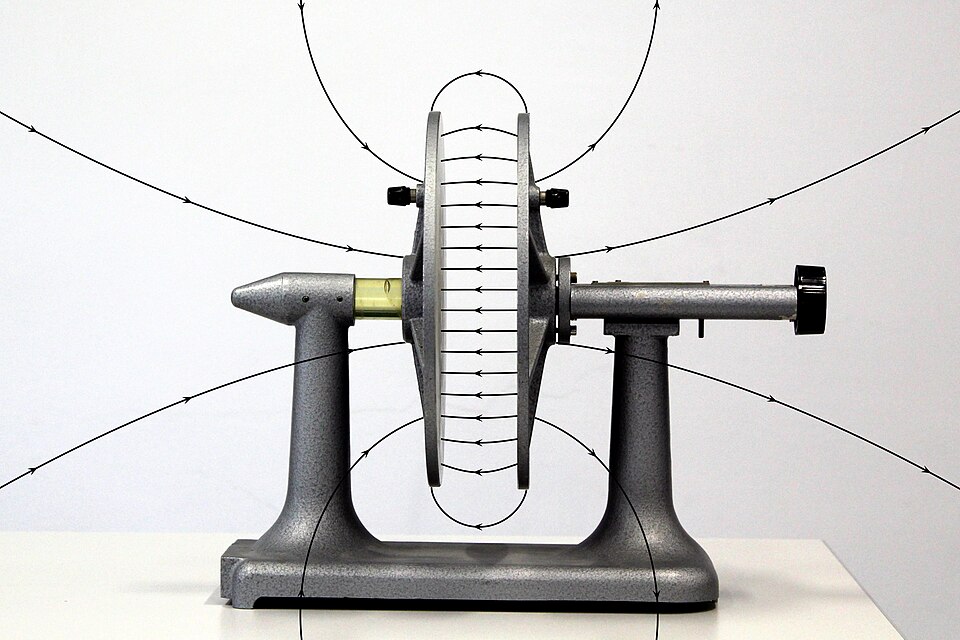
Energy is not just stored "in the plates" of a capacitor — it is stored in the electric field that fills the space between them. Expressing that stored energy as a density (energy per unit volume) makes it possible to compute total stored energy for any plate geometry just by multiplying by the field volume.This concept generalizes far beyond capacitors: the same energy-density expression describes the energy carried by any electric field, including the fields radiated as electromagnetic waves, making it a bridge between circuit-level capacitor analysis and field-level electromagnetics.
The electric field energy density is u = ½ε_0E². where eps_0 is the permittivity of free space, E_cap is the electric field strength between the plates, and u_field is the resulting energy density.
Inputs
eps_0 := 8.854e-12 F/m=8.85e-12 A^2·s^4/kg/m^3
E_cap := 100000 V/m=100000 kg·m/A/s^3
Apply the energy-density formula: because the field appears squared, doubling the field quadruples the stored energy per unit volume.
u_field := 0.5·eps_0·E_cap^2=0.04 Pa
Results
At a field of 100 kV/m — a strong but achievable value in a small air-gap capacitor — the stored energy density is still a fraction of a joule per cubic meter, illustrating how comparatively little energy air or vacuum can store per unit volume compared to a battery. Using a dielectric material with a higher permittivity in place of air would increase the stored energy density for the same field, which is exactly why real capacitors use dielectrics rather than an air gap.
Assumptions & limitations
- Uniform electric field (parallel-plate approximation, ignoring fringing).
- Vacuum/air permittivity used (no dielectric material).
- Static (non-time-varying) field.