Hohmann Transfer First-Burn Delta-v
Hohmann Transfer First-Burn Delta-v
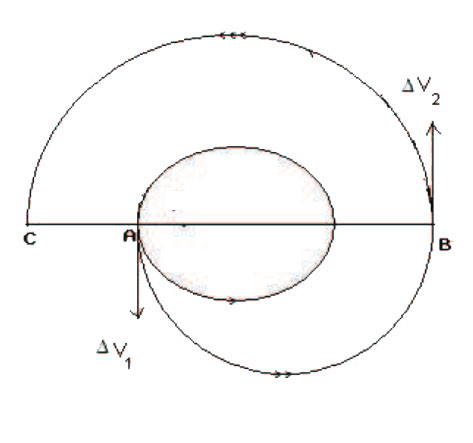
The Hohmann transfer is the most fuel-efficient two-impulse maneuver for moving a spacecraft from one circular orbit to another coplanar circular orbit, using an elliptical transfer path tangent to both — it is the standard baseline maneuver taught in every orbital mechanics course and used for everything from raising satellite orbits to sending probes to other planets. The first burn injects the spacecraft from its initial circular orbit onto the elliptical transfer orbit, and a second burn later circularizes at the target orbit; getting the first burn's magnitude and timing right is critical since any error propagates through the entire multi-day or multi-month transfer before it can be corrected.
The first-burn delta-v for a Hohmann transfer is dv1 = sqrt(mu/r1)*(sqrt(2*r2/(r1+r2)) - 1). where mu_e is the gravitational parameter of the central body, r_1 is the initial circular orbit radius, and r_2 is the target circular orbit radius.
Inputs
mu_e := 398600 km^3/s^2=3.99e+14 m^3/s^2
r_1 := 6678 km=6.68e+06 m
r_2 := 42164 km=4.22e+07 m
The sqrt(mu/r1) term is the initial orbit's circular velocity, and the bracket compares that to the velocity needed at perigee of the elliptical transfer orbit — the difference is the impulsive burn required.
dv_1 := sqrt(mu_e/r_1)·(sqrt(2·r_2/(r_1+r_2)) - 1)=2425.77 m/s
Results
This delta-v, on the order of a couple of kilometres per second for a low-Earth-orbit to geostationary-transfer maneuver, is a characteristic value for exactly this kind of orbit-raising burn used operationally to send satellites toward geostationary orbit. A second burn of a different magnitude is still required at apogee to circularize into the final target orbit — this first-burn value alone is only half the total transfer cost.
Assumptions & limitations
- Coplanar, circular initial and target orbits (no plane change included).
- Impulsive (instantaneous) burn assumed — real burns have finite duration.
- Two-body Keplerian dynamics; perturbations are neglected.
- This is only the first of two required burns for a complete Hohmann transfer.