Isentropic Stagnation Pressure from Mach Number
Isentropic Stagnation Pressure from Mach Number
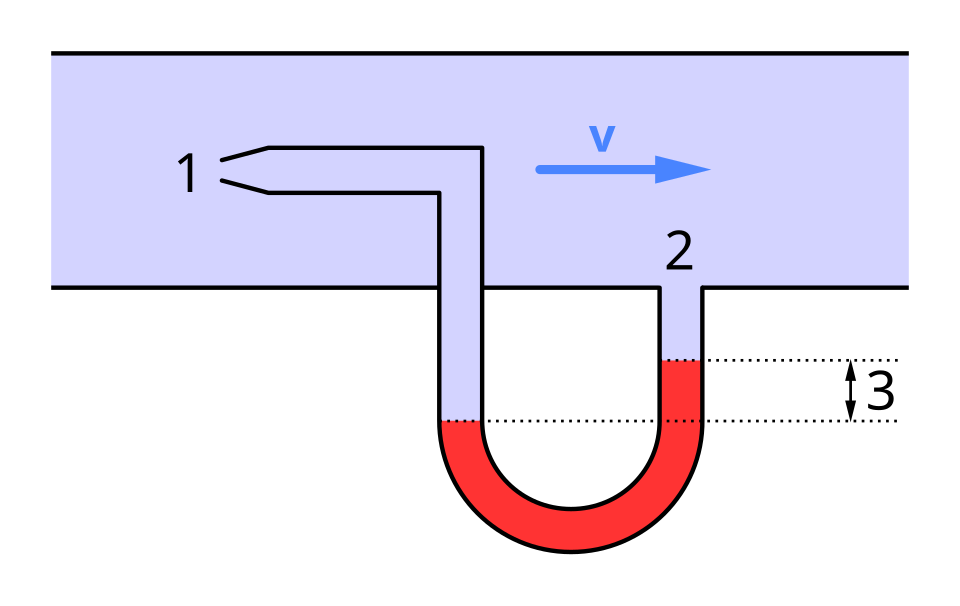
In high-speed compressible flow, the pressure a pitot tube reads (stagnation pressure) is noticeably higher than the surrounding static pressure because bringing the flow to rest isentropically converts its kinetic energy into additional pressure rise, an effect the incompressible Bernoulli equation underestimates once Mach number climbs above roughly 0.3. The isentropic stagnation-to-static pressure ratio, a function of Mach number and the gas's specific heat ratio alone, is exactly the relation used to convert a pitot-static airspeed measurement into true airspeed on high-speed aircraft, and it is also central to nozzle and inlet design throughout compressible flow engineering.
The isentropic stagnation pressure ratio is P0/P = (1+(k-1)/2·M^2)^(k/(k-1)), where M is the flow Mach number. where P is the static pressure, k is the gas's ratio of specific heats, M is the flow Mach number, and P0 is the resulting stagnation pressure.
Inputs
P_stat := 50000 Pa=50000 Pa
k_m := 1.4=1.4
M_no := 0.8=0.8
This is a genuinely dimensionally homogeneous isentropic relation with a dimensionless Mach number in the exponent base, so the fractional power can be applied directly to get the ratio of stagnation to static pressure.
ratio_p := (1 + (k_m-1)/2·M_no^2)^(k_m/(k_m-1))=1.52
Multiplying the static pressure by this ratio gives the actual stagnation pressure the flow would reach if brought isentropically to rest — the pressure a pitot tube facing directly into the flow would measure.
P_0s := P_stat·ratio_p=76217 Pa
Results
At Mach 0.8 the stagnation pressure runs about 34% above the static pressure, a correction too large to ignore at this speed — using the incompressible Bernoulli formula instead would noticeably underestimate the true stagnation pressure rise. This is precisely why aircraft air data computers apply the full compressible correction above roughly Mach 0.3, while below that threshold the simpler incompressible form is accurate enough for most engineering purposes. As Mach number approaches and exceeds 1, this subsonic isentropic relation still applies right up to the point of a shock wave forming, after which stagnation pressure loss through the shock must be accounted for separately.
Assumptions & limitations
- Isentropic (reversible, adiabatic) deceleration to stagnation conditions assumed.
- Ideal gas with constant specific heat ratio k.
- Subsonic or, if supersonic locally, upstream of any shock wave (no shock losses included).
- Static pressure P assumed already correctly measured or known.