Lewis Formula Gear Tooth Bending Stress
Lewis Formula Gear Tooth Bending Stress
A gear tooth acts like a small cantilever beam: the tangential force transmitted at the meshing point creates a bending moment at the tooth root, which is almost always where gear teeth fatigue and eventually fracture if overloaded. The Lewis formula was one of the earliest and remains one of the simplest ways to estimate this root bending stress from the tooth geometry and applied load.Tooth root fracture is a catastrophic gear failure mode — unlike surface wear or pitting, which degrade gradually and give warning through noise or vibration, a broken tooth can jam or destabilize an entire gear train almost instantly, so root bending stress is checked early in any gear design alongside surface (contact) stress.
The Lewis formula estimates root bending stress as sigma_g = W_t/(F_w·m_g·Y_l), the tangential load divided by face width, module, and the dimensionless Lewis form factor. where W_t is the tangential tooth load, F_w is the gear face width, m_g is the gear module (tooth size parameter), Y_l is the dimensionless Lewis form factor for the tooth geometry, and sigma_g is the resulting root bending stress.
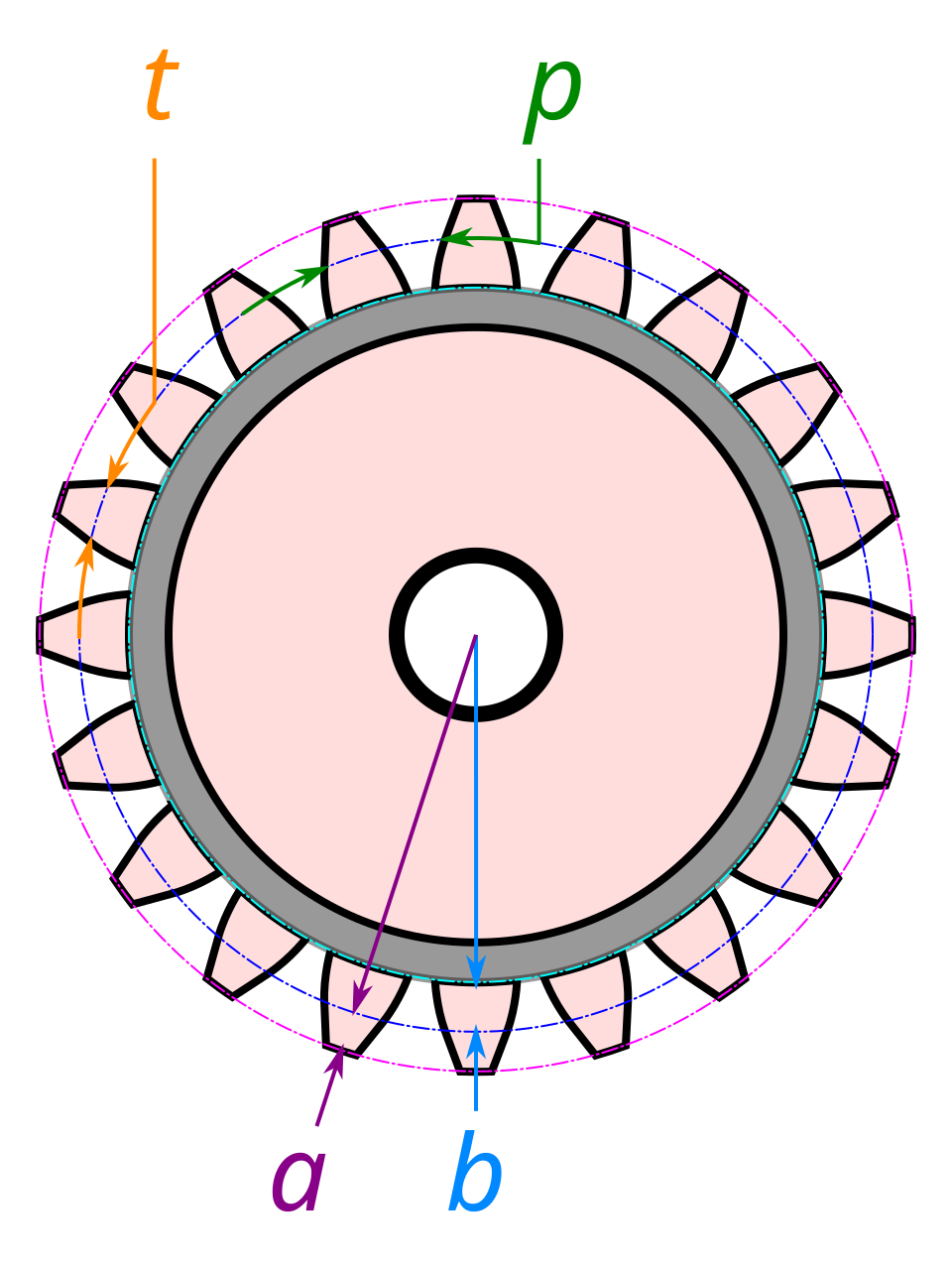
Inputs
W_t := 2000 N=2000 N
F_w := 25 mm=25 mm
m_g := 4 mm=4 mm
Y_l := 0.4=0.4
The Lewis formula packages the geometry of the tooth as a cantilever beam — face width, tooth size via the module, and a dimensionless shape factor — into a single expression that converts the tangential load directly into a root bending stress.
sigma_g := W_t/(F_w·m_g·Y_l)=50 MPa
Results
A root bending stress of 50 MPa for this gear would be compared against the allowable bending stress for the gear material and its fatigue rating, since gears in continuous service are almost always fatigue-limited rather than limited by a single static overload. Because module m_g relates directly to tooth size, a gear with a coarser module (bigger teeth) at the same face width and load will see proportionally lower root stress — this is one of the standard levers gear designers pull when a stress check fails, alongside widening the face. The basic Lewis formula does not include the dynamic load factor that accounts for impact loading from tooth meshing at speed, which real gear design applies on top of this static estimate.
Assumptions & limitations
- Static tangential load only — dynamic (velocity-dependent) load factors are not included in this basic Lewis form.
- Lewis form factor Y_l is a representative value for the given tooth geometry and pressure angle.
- Load is assumed applied at the tooth tip in the worst-case single-tooth-contact position.
- Only bending (root fracture) is checked; surface contact (pitting) stress is a separate calculation.