Load Factor in a Banked Turn
Load Factor in a Banked Turn
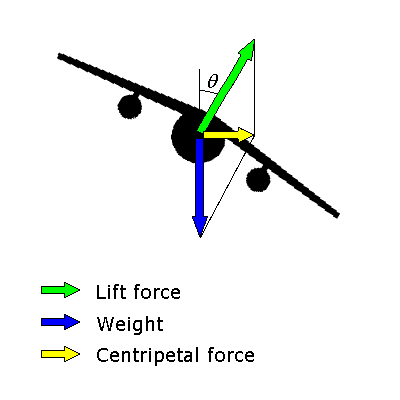
Whenever an aircraft banks to turn while holding altitude, its wings must generate more lift than its weight alone, because part of the lift vector is now tilted sideways to provide the centripetal force for the turn — the steeper the bank, the more total lift (and structural load) is required just to maintain level flight through the turn. Load factor grows without bound as bank angle approaches 90 degrees, which is why steep turns are both a structural concern (approaching the aircraft's certified g-limit) and an aerodynamic one (the stall speed rises with the square root of load factor, so a tight turn can stall an aircraft at a speed well above its normal 1g stall speed.
Load factor in a level, coordinated turn is n = 1/cos(phi). where phi_bank is the bank angle, in radians.
Inputs
phi_bank := 0.6981=0.7
Since only the vertical component of lift (lift times cos(phi)) supports the aircraft's weight in a level turn, the total lift — and hence the load factor — must increase as 1/cos(phi) to compensate for the tilt.
n_load := 1/cos(phi_bank)=1.31
Results
A 40-degree bank produces a load factor of about 1.3g, a moderate, comfortable value well within the structural and stall margins of ordinary flight. By 60 degrees of bank the load factor reaches 2g, and it climbs toward infinity as bank approaches 90 degrees — this steep, nonlinear growth is exactly why steep turns are flown cautiously and why aerobatic and fighter aircraft need much higher structural g-limits than typical transport aircraft.
Assumptions & limitations
- Level (constant-altitude), coordinated turn — no sideslip or climb/descent component.
- Steady-state turn at constant bank angle, not a rolling transient.
- Applies to the whole-aircraft load factor; local structural loads may vary by location.
- Does not include gust or maneuvering load factors beyond this steady turn.