Magnetic Force Between Two Parallel Current-Carrying Wires
Magnetic Force Between Two Parallel Current-Carrying Wires
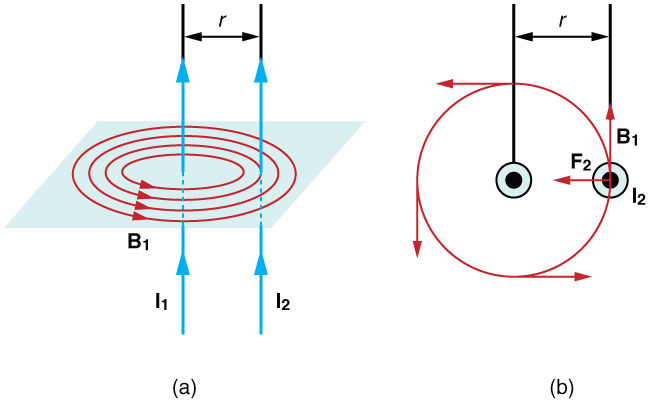
Two current-carrying wires exert a magnetic force on each other: parallel currents attract, opposite currents repel. This effect is strong enough to matter in real hardware — busbars in a switchgear cabinet, transformer windings, or motor conductors can physically deflect or vibrate under high fault currents, which is why this force per unit length is a standard mechanical check in electrical equipment design.Historically, this exact relationship was used to define the ampere itself before the SI redefinition: the ampere was the current that produces a specific force per meter between two infinite parallel wires one meter apart.
The force per unit length between the wires is F/L = μ_0·I_1·I_2/(2πd). where mu_0 is the permeability of free space, I_1 and I_2 are the currents in the two wires, d_wire is the separation between them, and F_per_L is the resulting force per unit length.
Inputs
mu_0 := 0.0000012566 H/m=1.26e-06 kg·m/A^2/s^2
I_1 := 10 A=10 A
I_2 := 15 A=15 A
d_wire := 0.05 m=50 mm
Combine the two currents, the wire separation, and the permeability of free space — the same relationship that once defined the ampere itself.
F_per_L := mu_0·I_1·I_2/(2·pi·d_wire)=6e-04 kg/s^2
Results
At these moderate currents and a 5 cm spacing the force per meter is small — on the order of a few millinewtons per meter — but this force scales with the product of the two currents, so a fault current spike (tens of kiloamps in a short circuit) can produce forces large enough to bend busbars or blow apart loosely braced conductors. This is exactly why switchgear designers size conductor bracing for worst-case fault current, not just normal operating current.
Assumptions & limitations
- Wires are long, straight, and parallel (infinite-wire approximation).
- Steady (DC or slowly varying) current.
- Vacuum/air permeability used (no ferromagnetic material nearby).