Maximum Load Factor from CLmax at Never-Exceed Speed
Maximum Load Factor from CLmax at Never-Exceed Speed
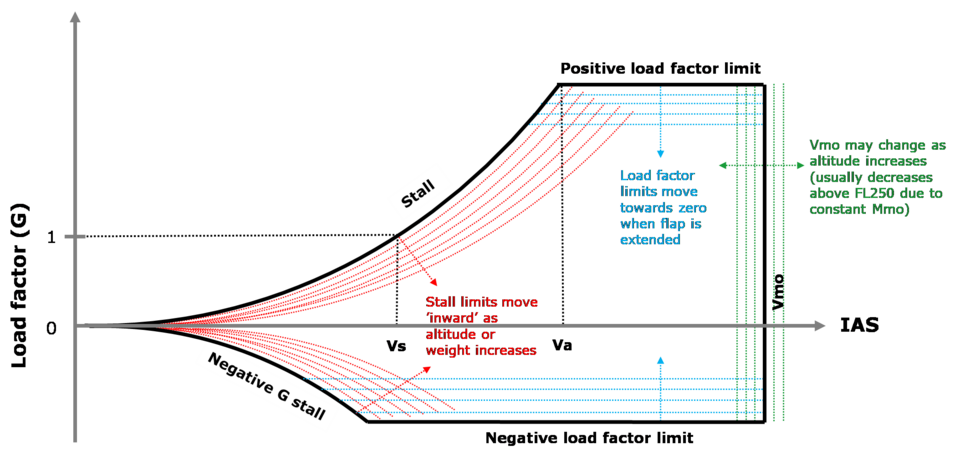
An aircraft's maximum achievable load factor at a given airspeed is set by how much lift its wings can generate before stalling — expressed through the maximum lift coefficient CLmax — and this relationship is exactly what defines the upper (positive stall) boundary of an aircraft's V-n (velocity versus load factor) diagram. At speeds below maneuvering speed, the aircraft stalls before it can reach its structural load limit, so the wing itself protects the airframe; above maneuvering speed, though, the aircraft can generate enough lift to exceed structural limits before stalling, which is exactly why never-exceed speed and maneuvering speed are both critical, separately-defined limits in every flight manual.
The aerodynamically achievable load factor is n = 0.5*rho*V^2*CLmax*S/W. where rho_a is air density, V_ne is the airspeed of interest (here, never-exceed speed), CL_max is the maximum lift coefficient, S_wing is wing reference area, and W_ac2 is aircraft weight.
Inputs
rho_a := 1.225 kg/m^3=1.23 kg/m^3
V_ne := 180 m/s=180 m/s
CL_max := 1.4=1.4
S_wing := 20 m^2=20 m^2
W_ac2 := 15000 N=15000 N
This is simply the standard lift equation evaluated at maximum lift coefficient and divided by weight, giving the highest load factor the wing can aerodynamically produce at this airspeed before stalling.
n_max := 0.5·rho_a·V_ne^2·CL_max·S_wing/W_ac2=37.04
Results
At a high speed like the never-exceed speed used here, the aerodynamically achievable load factor comes out far above any aircraft's actual structural limit, confirming that at this speed the airframe's structural limit — not a stall — is what would govern first; this is precisely the high-speed region of the V-n diagram where structural limits, not aerodynamic ones, bound safe maneuvering.
Assumptions & limitations
- Steady, quasi-static aerodynamic lift assumed — no dynamic gust or transient effects.
- CLmax treated as constant, though it varies somewhat with Reynolds number and configuration.
- Represents the aerodynamic (stall) boundary only — actual allowable n may be lower due to structural limits.
- Sea-level air density used; actual value should match the altitude of interest.