Minimum Fluidization Velocity (Simplified Force Balance)
Minimum Fluidization Velocity (Simplified Force Balance)
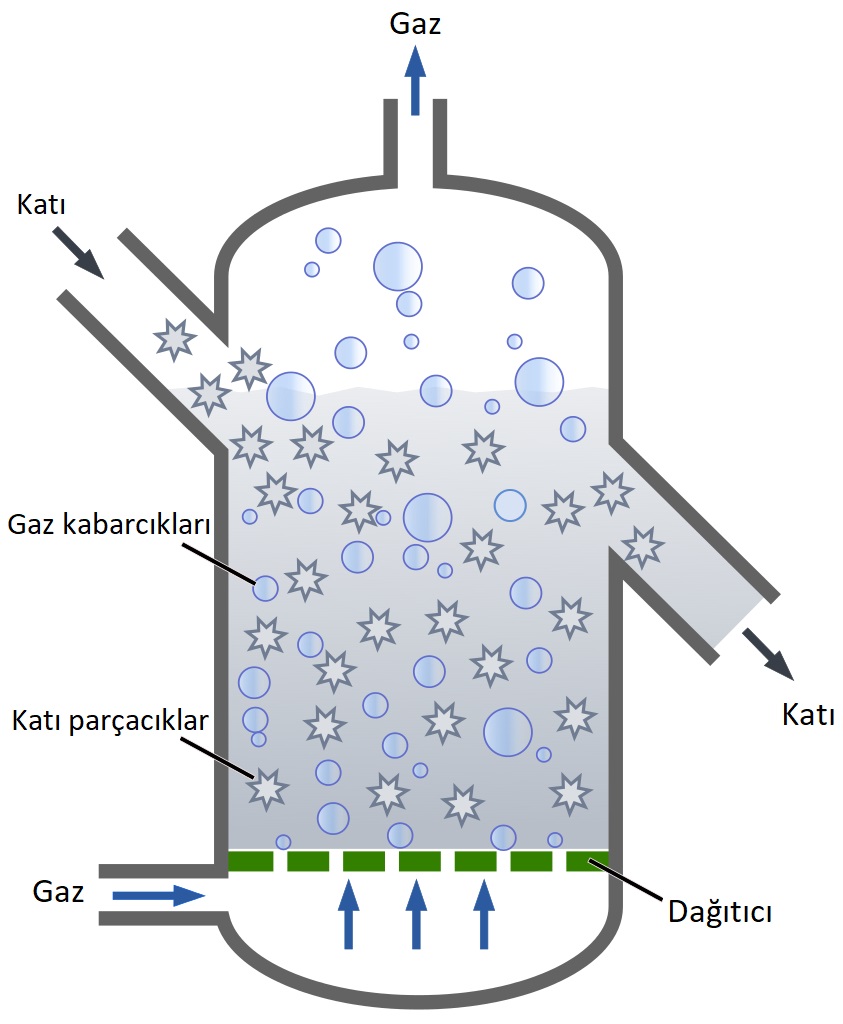
A fluidized bed reactor works by blowing gas up through a bed of solid particles fast enough that drag force lifts and suspends them, turning the bed into a fluid-like mixture with excellent heat and mass transfer — used everywhere from catalytic cracking to combustion of solid fuels. Below the minimum fluidization velocity the bed just sits there as a packed bed with gas trickling through it; above it the particles become suspended and mobile, so getting this velocity right is the difference between a functioning fluidized bed and either a stagnant packed bed or particles blown straight out of the vessel.
A simplified terminal-velocity-style force balance gives v_mf = sqrt(4·g·d_p·(rho_s - rho_f) / (3·C_d·rho_f)). where g is gravitational acceleration, d_p is the particle diameter, rho_s and rho_f are the particle and fluid densities, and C_d is the particle drag coefficient.
Inputs
g_grav := 9.81 m/s^2=9.81 m/s^2
d_p := 0.0005 m=0.5 mm
rho_s := 2500 kg/m^3=2500 kg/m^3
rho_f := 1.2 kg/m^3=1.2 kg/m^3
C_d := 0.44=0.44
This is the same force-balance form used for terminal settling velocity, just applied at the point where drag exactly supports the particle's buoyant weight — the threshold of fluidization.
v_mf := sqrt((4·g_grav·d_p·(rho_s-rho_f))/(3·C_d·rho_f))=5.56 m/s
Results
The computed velocity, on the order of a few tenths of a meter per second for fine sand-like particles in air, is the superficial gas velocity the blower must supply just to reach fluidization — operating velocities in real beds are typically set at several times v_mf for stable, vigorous fluidization. Running below v_mf leaves the bed packed and starves the process of the mixing it needs, while running far above it risks excessive particle entrainment (carryover) out of the vessel. This simplified form is only a first estimate; real minimum fluidization velocity depends on bed voidage and particle shape as well.
Assumptions & limitations
- Spherical particles of uniform size assumed.
- Drag coefficient C_d treated as constant rather than Reynolds-number dependent.
- Neglects bed voidage effects captured in the fuller Ergun-equation form.
- Single-particle force balance, not a full packed-bed pressure-drop model.