Moment of Inertia of a Solid Sphere
Moment of Inertia of a Solid Sphere
A solid sphere spinning about an axis through its center — a ball, a rotor, a planet — has a moment of inertia that is smaller relative to its mass and radius than a disc or a hoop of the same dimensions, because more of its mass sits close to the rotation axis rather than out at the rim.This shape factor is exactly why a solid sphere rolls down an incline faster than a disc or a hollow shell of the same mass and radius: less of its kinetic energy is tied up in rotation for a given rolling speed, since its moment of inertia coefficient (2/5) is smaller than a disc's (1/2) or a hoop's (1).
The moment of inertia of a uniform solid sphere about a diameter is I = (2/5)mr². where m_sph is the sphere mass, r_sph is the sphere radius, and I_sph is the resulting moment of inertia.
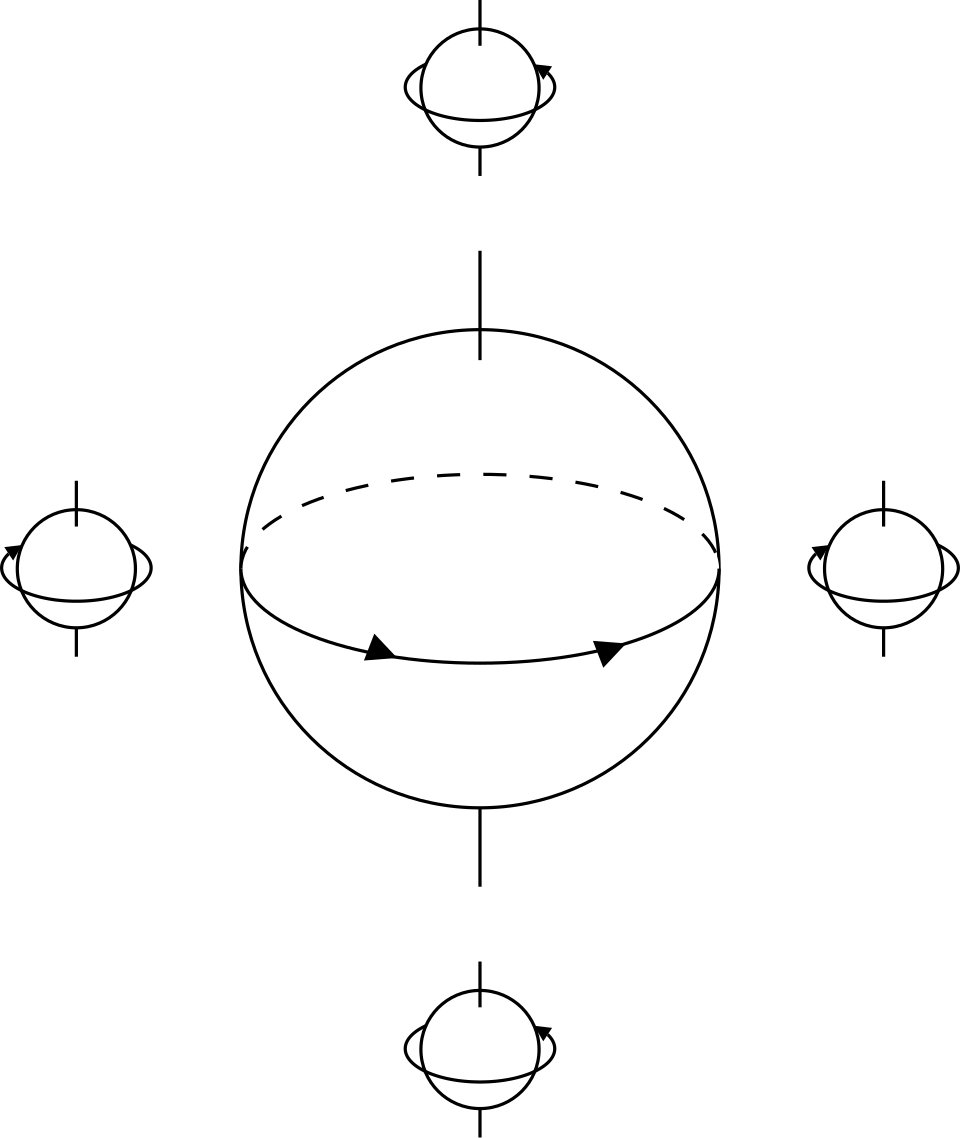
Inputs
m_sph := 8 kg=8 kg
r_sph := 0.15 m=150 mm
Apply the solid-sphere moment of inertia formula, using the 2/5 shape factor characteristic of a sphere with mass spread throughout its volume rather than concentrated at the rim.
I_sph := 0.4·m_sph·r_sph^2=0.07 kg·m^2
Results
An 8 kg sphere of 0.15 m radius has a small moment of inertia, consistent with how compactly its mass is distributed close to the rotation axis. For the same mass and radius, a thin spherical shell would have a moment of inertia two-thirds larger ((2/3)mr² versus (2/5)mr²) since shell mass sits entirely at the outer radius rather than filling the interior.
Assumptions & limitations
- Uniform density throughout the sphere.
- Rotation about an axis through the center (a diameter).
- Rigid body (no deformation under rotation).