Parallel Axis Theorem
Parallel Axis Theorem
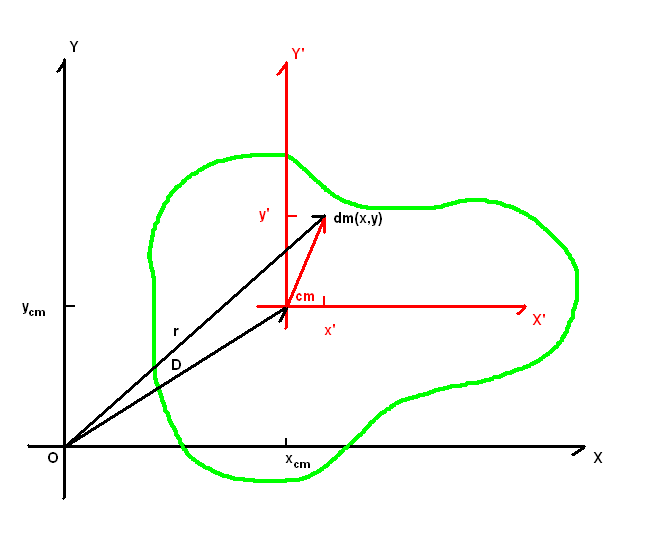
The moment of inertia of a body depends on which axis it rotates about, and most real rotating assemblies do not spin exactly about their own center of mass — a connecting rod, a counter-weight, or an eccentric cam all rotate about some offset axis. The parallel axis theorem provides a simple correction that avoids re-deriving the moment of inertia from scratch for every new axis.This theorem is a workhorse in machine design and structural dynamics: rather than integrating mass distributions repeatedly, engineers look up (or compute) a body's moment of inertia about its own centroid once, then shift it to whatever axis actually matters using this single added term.
The parallel axis theorem gives I_new = I_cm + md², where d is the distance between the offset axis and the center-of-mass axis. where I_cm2 is the moment of inertia about the center-of-mass axis, m_pat is the body mass, d_pat is the distance to the new parallel axis, and I_new is the resulting moment of inertia about that offset axis.
Inputs
I_cm2 := 0.08 kg·m^2=0.08 kg·m^2
m_pat := 5 kg=5 kg
d_pat := 0.3 m=300 mm
Add the "shifted mass" term md² to the center-of-mass moment of inertia — this term alone accounts for the entire effect of moving the rotation axis away from the center of mass.
I_new := I_cm2 + m_pat·d_pat^2=0.53 kg·m^2
Results
Shifting the axis by 0.3 m more than doubles the moment of inertia compared to spinning about the center of mass alone, since the added md² term is larger here than the original I_cm. This is why off-axis rotating components — like an eccentric counterweight — feel disproportionately harder to spin up than their center-of-mass moment of inertia alone would suggest, and why balancing (keeping rotation close to the center of mass) matters for smooth, efficient machinery.
Assumptions & limitations
- Rigid body, offset axis parallel to the original center-of-mass axis.
- d_pat measured as the perpendicular distance between the two axes.
- Uniform mass distribution assumed for I_cm (as usually looked up or computed separately).