PFR Conversion for a First-Order Reaction
PFR Conversion for a First-Order Reaction
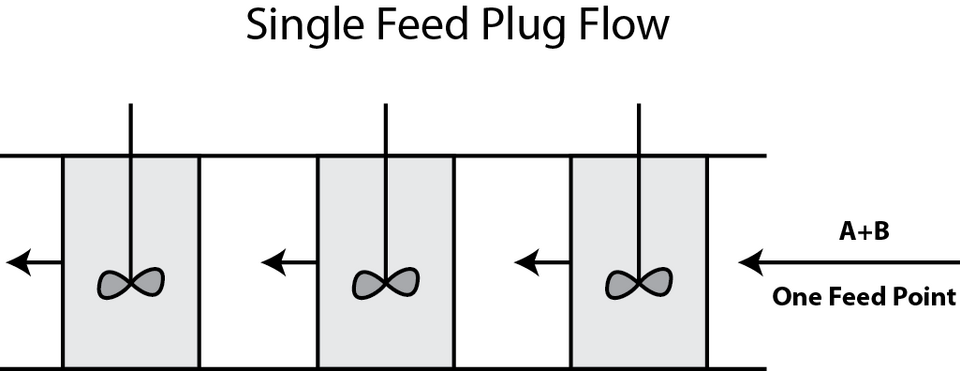
A plug-flow reactor (PFR) — reactant flowing steadily down a long tube or packed bed with no back-mixing — behaves very differently from a stirred tank, and for the common case of a first-order reaction its conversion has a clean closed-form solution built from the rate constant and the time the fluid spends inside. This exponential relationship is why PFRs are generally more efficient than CSTRs for the same volume and average concentration driving force: conversion climbs quickly at first and then approaches completion asymptotically, so engineers use it to judge whether a given reactor length is even worth building versus accepting a lower conversion.
The fractional conversion is X = 1 - exp(-k·tau), where the reaction is first order in the limiting reactant. where k is the first-order rate constant and tau is the reactor residence time.
Inputs
k_rate := 0.05 min^-1=8.33e-04 Hz
tau_res := 20 min=1200 s
The exponential term exp(-k·tau) is the fraction of reactant that survives unreacted after time tau, so one minus that term is the fraction that has been converted to product.
X_conv := 1 - exp(-k_rate·tau_res)=0.63
Results
A conversion around 0.63 (63%) is typical of a reactor sized for roughly one time constant (k·tau = 1), which is often a reasonable economic sweet spot since conversion climbs fast early on but needs disproportionately more residence time to approach 100%. Pushing for 95% conversion, for example, would require tripling tau even though the gain in product is only about 50% more than at 63%. If the reaction is not truly first order this formula no longer applies and the actual rate law must be integrated instead.
Assumptions & limitations
- Ideal plug flow — no axial mixing or dispersion.
- Isothermal reactor (rate constant k does not vary along the length).
- Single, irreversible, first-order reaction.
- Constant volumetric flow rate through the reactor.