Projectile Range with a Launch Height Above the Landing Point
Projectile Range with a Launch Height Above the Landing Point
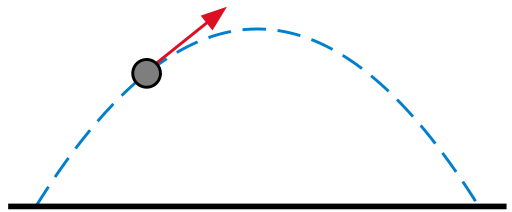
The familiar flat-ground projectile range formula assumes the launch and landing points are at the same height, but many real situations — a ball thrown from a cliff, a shot put released from shoulder height, an artillery piece firing from elevated ground — start higher than they land. The extra fall height adds to the flight time and therefore to the range.Accounting for launch height correctly matters in sports science (a shot put or javelin is released well above the ground it lands on) and in ballistics, where ignoring even a modest launch height can noticeably underestimate how far a projectile actually travels.
The time of flight for launch height h_0 above the landing point is t = (v_0 sin θ + sqrt((v_0 sin θ)² + 2gh_0))/g, and the range is R = v_0 cos θ · t. where v_0p is the launch speed, theta_p is the launch angle, g_p is gravitational acceleration, h_0p is the launch height above the landing surface, t_flight is the time of flight, and R_proj is the resulting horizontal range.
Inputs
v_0p := 25 m/s=25 m/s
theta_p := 0.6109=0.61
g_p := 9.81 m/s^2=9.81 m/s^2
h_0p := 10 m=10 m
Solve the vertical motion equation for the time of flight — the extra term under the square root accounts for the added time gained by falling the extra launch height before landing.
t_flight := (v_0p·sin(theta_p) + sqrt((v_0p·sin(theta_p))^2 + 2·g_p·h_0p))/g_p=3.51 s
Multiply the horizontal velocity component by the total flight time to get the horizontal distance traveled.
R_proj := v_0p·cos(theta_p)·t_flight=71.78 m
Results
Launching from 10 m up adds noticeably to the range compared to the flat-ground case, since the extra height buys extra flight time for the horizontal velocity component to keep carrying the projectile forward. If h_0p were set to zero, this formula collapses exactly to the standard flat-ground range formula, which is a useful check that the extended formula is behaving correctly.
Assumptions & limitations
- No air resistance (vacuum trajectory).
- Level landing surface below the launch point.
- Constant gravitational acceleration throughout the flight.
- Launch point treated as a point mass (no projectile size/spin effects).