Relativistic Time Dilation
Relativistic Time Dilation
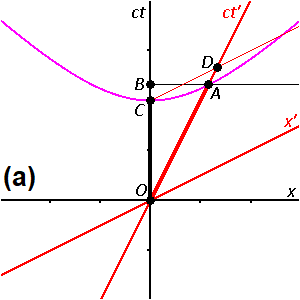
Special relativity predicts that a moving clock runs slow as seen by a stationary observer — not because of any mechanical effect on the clock, but because time itself passes at a different rate between reference frames moving relative to each other. At everyday speeds this effect is utterly negligible, but it becomes measurable at a meaningful fraction of the speed of light.This is not just a theoretical curiosity: GPS satellites, which orbit fast enough (and sit in a different gravitational potential) for relativistic effects to matter, must have their onboard clocks corrected for exactly this kind of time dilation, or the resulting position errors would accumulate to kilometers per day.
The dilated time interval is t = t_0/sqrt(1 − (v/c)²), where t_0 is the time interval measured in the moving frame. where t_0 is the proper time interval measured by the moving clock, v_rel is its speed, c_light is the speed of light, and t_dilated is the elapsed time measured by the stationary observer.
Inputs
t_0 := 1 s=1 s
v_rel := 24000000 m/s=2.4e+07 m/s
c_light := 299792458 m/s=3e+08 m/s
Express the speed as a fraction of the speed of light — this dimensionless ratio is what actually controls the size of the relativistic effect.
ratio_vc := v_rel/c_light=0.08
Apply the time-dilation factor: at low v/c this factor is barely above 1, but it grows sharply as v approaches c.
t_dilated := t_0/sqrt(1 - ratio_vc^2)=1 s
Results
At 8% of the speed of light, one second in the moving frame stretches to only slightly more than one second for the stationary observer — a tiny but nonzero effect at this speed. The dilation factor grows very slowly at first but diverges as v approaches c, meaning a spacecraft would need to reach a much larger fraction of light speed (well above 50%) before time dilation became a dramatic, easily noticeable effect.
Assumptions & limitations
- Special relativity (flat spacetime, no gravitational effects).
- Constant relative velocity between the two frames (no acceleration during the interval).
- v_rel is well below c so the sqrt argument stays positive.