Rotational Kinetic Energy
Rotational Kinetic Energy
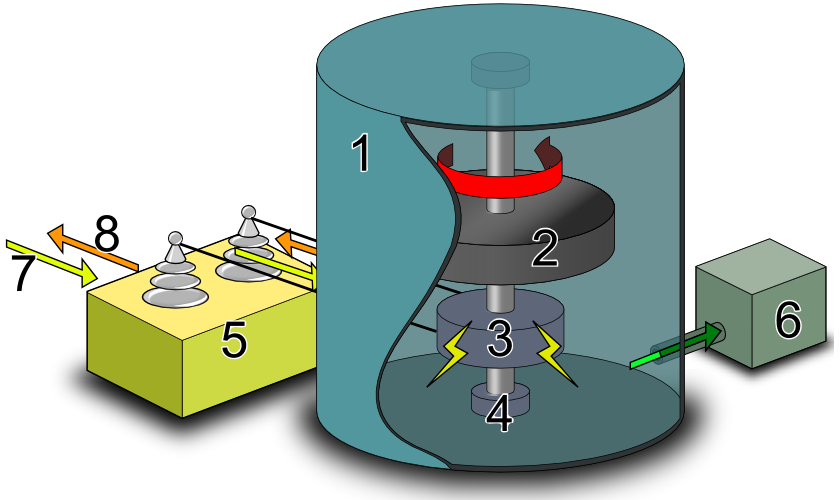
Just as a moving mass stores translational kinetic energy, a spinning body stores rotational kinetic energy — the working principle behind the flywheel, one of the oldest mechanical energy-storage devices, used to smooth out engine power delivery and, in modern grid-scale flywheel systems, to store and release electrical energy on demand.Because this energy scales with the square of angular velocity, spinning a flywheel faster is a far more effective way to store energy than making it heavier — which is why high-speed composite flywheels can store meaningful energy in a comparatively compact, lightweight package.
Rotational kinetic energy is KE = ½Iω², where the angular velocity ω is related to the rotation frequency by ω = 2πf. where I_rot2 is the moment of inertia of the rotating body, f_rot3 is its rotation frequency, omega_rot2 is the corresponding angular velocity, and KE_rot is the resulting rotational kinetic energy.
Inputs
I_rot2 := 3 kg·m^2=3 kg·m^2
f_rot3 := 4 Hz=4 Hz
Convert the rotation frequency into angular velocity in radians per second, the form the energy formula needs.
omega_rot2 := 2·pi·f_rot3=25.13 Hz
Apply the rotational kinetic energy formula — because ω is squared, a small increase in spin speed stores disproportionately more energy.
KE_rot := 0.5·I_rot2·omega_rot2^2=947.48 Nm
Results
At 4 revolutions per second, this moment of inertia stores several hundred joules of rotational kinetic energy — enough to do meaningful mechanical work as the flywheel spins down. Because energy scales with ω², doubling the rotation speed would quadruple the stored energy, which is the main reason modern flywheel energy-storage systems favor high rotational speeds over simply adding mass.
Assumptions & limitations
- Rigid body with constant moment of inertia during the spin.
- Rotation about a fixed axis (no precession or wobble).
- No energy losses considered (friction, air drag) during storage.