Siphon Discharge Velocity
Siphon Discharge Velocity
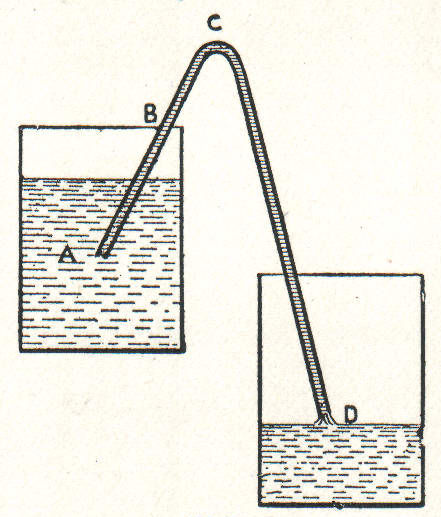
A siphon moves liquid over a rise and down to a lower discharge point without any pump, relying only on gravity and atmospheric pressure to sustain the flow once it is primed. The idealized discharge velocity follows directly from energy conservation between the free surface and the outlet, the same relationship that governs a simple free-falling jet from an orifice. Real siphons discharge somewhat slower than this ideal value because of pipe friction and, at the high point of the siphon, need enough positive pressure margin to avoid the flow breaking due to cavitation or air ingress — a common failure mode when the siphon crest is set too high above the reservoir surface.
The idealized (frictionless) siphon discharge velocity is v = sqrt(2*g*h). where g_s is gravitational acceleration and h_s2 is the elevation drop from the reservoir surface to the discharge point.
Inputs
g_s := 9.81 m/s^2=9.81 m/s^2
h_s2 := 3 m=3 m
This is simply Torricelli's result applied to the outlet: all of the elevation head converts to velocity head if friction is neglected.
v_siphon := sqrt(2·g_s·h_s2)=7.67 m/s
Results
A 3 m drop gives an outlet velocity approaching 8 m/s, a brisk but plausible value for a lab or moderate-head siphon; real installations run somewhat below this because of pipe and fitting losses, so this value should be treated as an upper bound. If the measured discharge is noticeably lower, check first for air entrainment at the crest or excessive pipe length before assuming a blockage.
Assumptions & limitations
- Frictionless, ideal flow — no pipe or entrance losses included.
- Siphon assumed fully primed with no air in the line.
- Crest height not checked here for cavitation/vapor-pressure limits.
- Steady-state discharge; start-up transients are ignored.