Specific Energy in an Open Channel
Specific Energy in an Open Channel
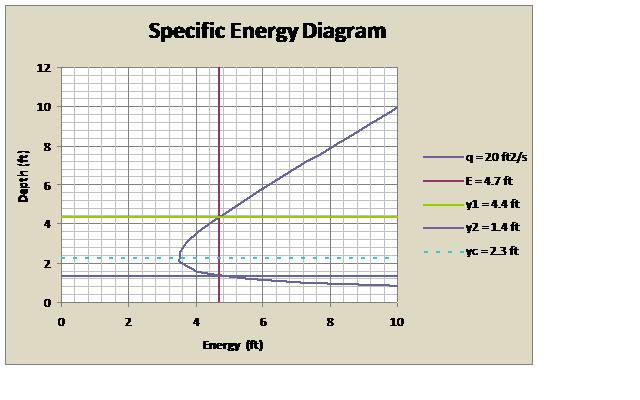
Specific energy is the total mechanical energy of open-channel flow measured relative to the channel bed — the sum of flow depth (a stand-in for pressure/potential energy) and velocity head (kinetic energy) — and plotting it against depth for a fixed discharge produces the specific energy diagram that underlies nearly all open-channel hydraulics analysis, from predicting water surface profiles to explaining why flow chokes at a constriction. For any given discharge there are generally two depths (a subcritical and a supercritical one) that share the same specific energy, and the minimum-energy point between them is exactly the critical depth — so computing specific energy at a known depth is the first step toward analyzing transitions, constrictions, and controls in a channel.
The specific energy is E = y + q^2/(2·g·y^2), depth plus velocity head expressed in terms of unit discharge. where y is the flow depth, q is the discharge per unit channel width, and g is gravitational acceleration.
Inputs
y_e := 0.8 m=800 mm
q_e := 2 m^2/s=2 m^2/s
g_e := 9.81 m/s^2=9.81 m/s^2
Adding the flow depth to the velocity head computed from unit discharge and depth gives the total specific energy the flow carries relative to the channel bed at this cross-section.
E_spec := y_e + q_e^2/(2·g_e·y_e^2)=1.12 m
Results
A specific energy around 1.12 m at a flow depth of 0.8 m means the velocity head contributes roughly 0.32 m on top of the depth itself — a moderate but not negligible fraction of the total, indicating this flow is relatively fast for its depth. Comparing this depth against the critical depth for the same unit discharge tells whether the flow is subcritical or supercritical: at depths well above critical, specific energy changes only slowly with depth, while near critical depth even a small change in depth causes a large change in energy, which is exactly what makes flow near critical depth so unstable and prone to standing waves.
Assumptions & limitations
- Rectangular (or wide) channel with uniform velocity distribution across the section.
- Hydrostatic pressure distribution assumed.
- Kinetic energy correction factor taken as 1 (uniform velocity profile).
- No energy losses included — this is the energy at a single section, not a profile between sections.