Stopping Sight Distance
Stopping Sight Distance
Stopping sight distance (SSD) is the length of roadway a driver needs to see clearly ahead in order to perceive a hazard, react, and brake to a complete stop before reaching it. It is the single most fundamental control in geometric highway design, governing minimum crest-curve lengths, horizontal curve offsets, and sign placement.Highway agencies size SSD for a design speed rather than the posted speed, and build in a conservative reaction time, because the consequence of underestimating it is a driver who sees a stalled vehicle or debris too late to avoid a collision.
The stopping distance is the sum of the reaction distance and the braking distance, SSD = v·t_r + v²/(2·g·f). where v is the design speed, t_r is the perception-reaction time, g is gravitational acceleration, and f is the coefficient of friction between tire and pavement.
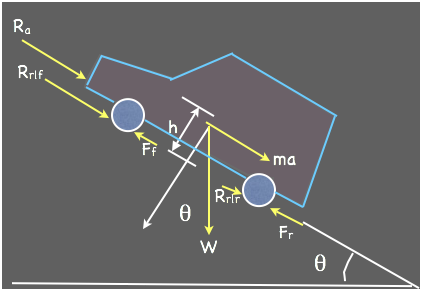
Inputs
v_s := 25 m/s=25 m/s
t_r := 2.5 s=2.5 s
g := 9.81 m/s^2=9.81 m/s^2
f_fr := 0.35=0.35
During the reaction time the vehicle travels at constant speed before the brakes are even applied.
d_react := v_s·t_r=62.5 m
Once braking begins, friction decelerates the vehicle from its design speed to zero over the braking distance.
d_brake := v_s^2/(2·g·f_fr)=91.01 m
Adding the two gives the total sight distance the roadway must provide.
SSD := d_react + d_brake=153.51 m
Results
For a 90 km/h design speed, SSD typically lands in the 150–170 m range, and this result is consistent with published AASHTO tables. Wet pavement or a lower friction coefficient pushes the braking term up sharply since it depends on 1/f, which is why SSD is often the governing constraint on crest vertical curve length. If a road has less sight distance than this value at any point, the design speed must be lowered or the obstruction removed.
Assumptions & limitations
- Level roadway grade (no grade correction applied).
- Dry pavement friction; wet conditions reduce f_fr substantially.
- Perception-reaction time is a single design value, not driver-specific.
- Braking is treated as constant deceleration, not ABS-limited.