Superelevation Rate for a Horizontal Curve
Superelevation Rate for a Horizontal Curve
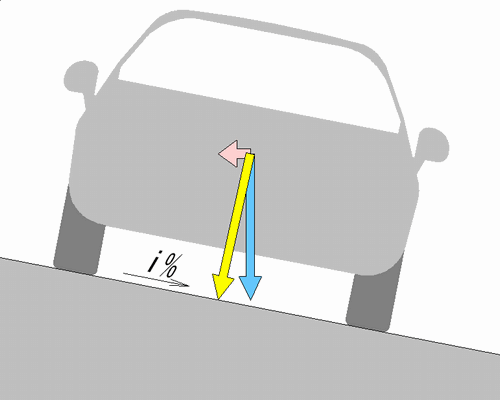
When a vehicle travels around a horizontal curve, the roadway is tilted (superelevated) so that part of the cornering force is carried by gravity rather than relying entirely on tire friction. This lets vehicles negotiate the curve comfortably and safely at the design speed.Too little superelevation forces drivers to rely on friction that may not be available in wet or icy conditions, risking a skid off the outside of the curve; too much superelevation causes slow vehicles to slide toward the inside on the same wet pavement — so agencies compute e for a specific design speed and radius rather than guessing.
The required superelevation rate is e = v²/(g·R) − f, the total cornering demand minus the portion carried by side friction. where v is the design speed, R is the curve radius, g is gravitational acceleration, and f is the assumed side-friction factor.
Inputs
v_c := 20 m/s=20 m/s
R_c := 250 m=250 m
f_side := 0.12=0.12
g := 9.81 m/s^2=9.81 m/s^2
The total lateral acceleration demand v²/(gR) is split between pavement banking and tire friction; subtracting the friction share leaves the required banking rate.
e_rate := v_c^2/(g·R_c) - f_side=0.04
Results
A value like e ≈ 0.04 (a 4% cross slope) is a normal, buildable superelevation rate — most highway standards cap e around 0.06 to 0.08 for general roads and higher for high-speed rural highways. If e comes out negative, the curve is generous enough that no banking is needed at all; if it exceeds the agency maximum, the radius must be increased or the design speed lowered.
Assumptions & limitations
- Steady-state circular motion; transition spirals not modeled.
- Side-friction factor is a design assumption, not a measured value.
- Superelevation runoff length and drainage are not addressed here.