Takeoff Ground Roll Distance (Simplified)
Takeoff Ground Roll Distance (Simplified)
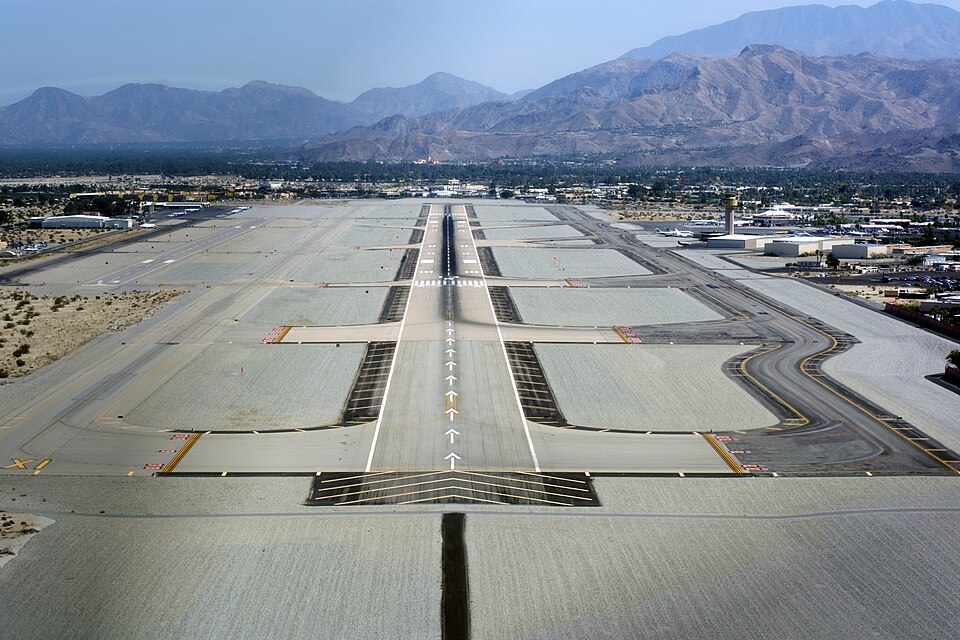
Before an aircraft leaves the ground it must accelerate down the runway from a standstill to its takeoff speed, and the length of runway that takes is one of the first numbers an airport planner or pilot needs. A simple constant-acceleration kinematic model gives a quick, reasonable estimate of that ground roll.Runways that are too short for a given aircraft’s ground roll force reduced payload or fuel load to hit a lower takeoff speed — which is why this distance, scaled up with safety margins, directly drives minimum runway length requirements at an airport.
From kinematics, v² = 2·a·L, so the ground roll is L = v²/(2·a). where v is the takeoff speed and a is the average acceleration during the ground roll.
Inputs
v_to := 70 m/s=70 m/s
a_to := 2.2 m/s^2=2.2 m/s^2
Rearranging the constant-acceleration kinematic equation gives the distance needed to reach takeoff speed from a standing start.
L_roll := v_to^2/(2·a_to)=1113.64 m
Results
A ground roll around 1100 m is typical for a mid-size jet transport at a realistic average acceleration; lighter aircraft or higher thrust-to-weight ratios shorten this distance considerably. Because the distance scales with the square of takeoff speed, a hot-and-high airport (which raises the required takeoff speed) disproportionately lengthens the required runway.
Assumptions & limitations
- Constant average acceleration assumed (real thrust/drag vary with speed).
- Zero wind and level, dry runway.
- No allowance for engine failure or rejected takeoff distance.