Turbojet Thrust (Simplified Momentum Form)
Turbojet Thrust (Simplified Momentum Form)
At its core, a jet engine produces thrust by accelerating a mass of air rearward — Newton's third law means the reaction on the engine is forward thrust. The simplified momentum form of the thrust equation captures this essential physics without the added complexity of pressure-area terms or fuel mass addition, and is the starting point every propulsion textbook uses before adding those refinements. Because thrust in this simplified form depends on the difference between exhaust and flight velocity, a jet engine loses thrust as flight speed increases even at constant exhaust velocity — this inherent thrust lapse with airspeed is a key reason turbojets are best suited to high-speed flight regimes rather than low-speed, high-thrust applications like takeoff assist.
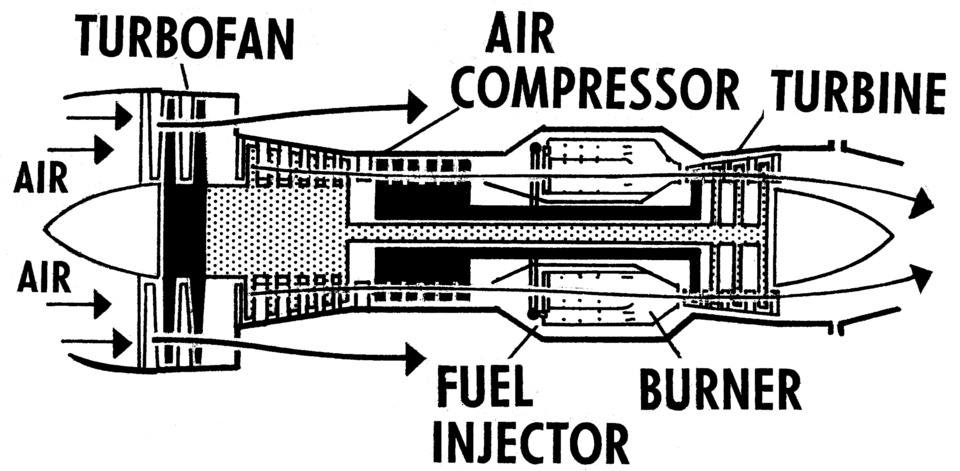
Simplified turbojet thrust is F = mdot*(Ve - V0), mass flow rate times the change in velocity through the engine. where mdot_jet is the air mass flow rate through the engine, V_e is the exhaust jet velocity, and V_0 is the aircraft's flight (freestream) velocity.
Inputs
mdot_jet := 40 kg/s=40 kg/s
V_e := 500 m/s=500 m/s
V_0 := 200 m/s=200 m/s
Thrust is simply the rate of momentum added to the air stream — mass flow rate times how much its velocity increased passing through the engine.
F_thrust := mdot_jet·(V_e - V_0)=12000 N
Results
A thrust of around 12 kN here is representative of a small turbojet at cruise conditions, and this value would typically be checked against installed drag to confirm the aircraft can sustain or accelerate at this flight speed. A full engine thrust equation also adds a pressure-area term (nozzle exit pressure above ambient) and accounts for the added fuel mass flow, both neglected in this simplified momentum form — real thrust is usually somewhat higher than this estimate as a result.
Assumptions & limitations
- Neglects the pressure-area thrust term (assumes fully expanded nozzle flow).
- Neglects fuel mass addition — treats mass flow as constant through the engine.
- One-dimensional, steady flow through the engine assumed.
- Installed (airframe) effects such as inlet losses are not included.