Vibration Isolation Transmissibility
Vibration Isolation Transmissibility
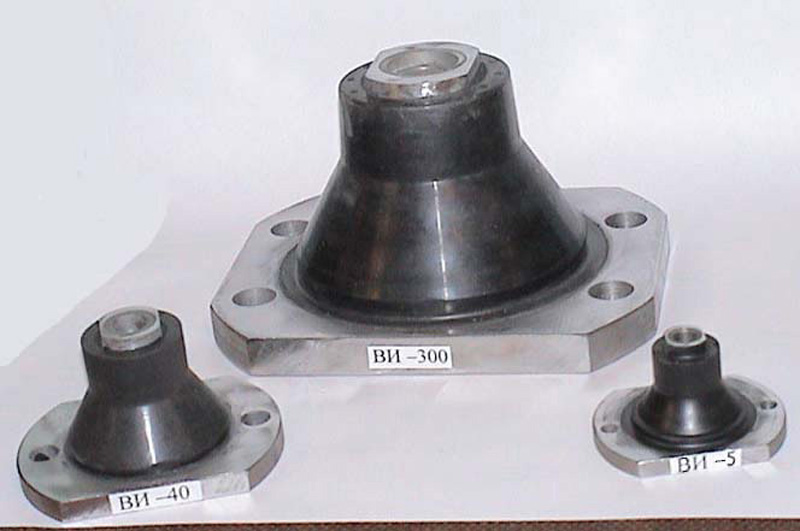
Vibration isolation mounts are placed under machinery specifically to reduce how much of the machine's vibrating force is transmitted into the supporting structure — or, run the other way, to reduce how much ground or floor vibration reaches sensitive equipment. Whether an isolator actually helps or makes things worse depends entirely on the ratio between the forcing frequency and the mount's own natural frequency, captured in the transmissibility ratio.A common and costly design mistake is selecting an isolator whose natural frequency is too close to the forcing frequency, since transmissibility spikes dramatically (in theory to infinity for an undamped system) right at resonance — effective isolation only begins once the forcing frequency is significantly above the mount's natural frequency, typically requiring a frequency ratio of at least about 1.4 to even start reducing transmitted force below the unmounted case.
For an undamped isolator with forcing frequency above resonance (r > 1), the transmissibility is TR = 1/(r_freq^2 - 1), where r_freq is the ratio of forcing frequency to natural frequency. where f_forc is the forcing (excitation) frequency, f_n is the natural frequency of the isolator-mass system, r_freq is the resulting frequency ratio, and TR is the transmissibility — the fraction of the forcing amplitude actually transmitted through the mount.
Inputs
f_forc := 30 Hz=30 Hz
f_n := 10 Hz=10 Hz
Dividing the forcing frequency by the mount's natural frequency gives the frequency ratio that determines whether the isolator is helping (ratio well above 1) or hurting (ratio near 1, at resonance).
r_freq := f_forc/f_n=3
Applying the undamped transmissibility formula to this frequency ratio gives the fraction of the vibrating force that actually makes it through the isolator into the support.
TR := 1/(r_freq^2 - 1)=0.12
Results
A transmissibility of 0.125 here means only about 12.5% of the forcing amplitude is transmitted through the mount — a well-isolated condition, achieved because the forcing frequency (30 Hz) is three times the mount's natural frequency (10 Hz), comfortably past the resonance region. If the machine's operating speed were closer to the mount's natural frequency, transmissibility would rise sharply rather than fall, so a soft enough mount (low natural frequency) relative to the actual operating speed range is essential — including during startup and shutdown, when the machine sweeps slowly through all frequencies including resonance. Real isolators include some damping, which slightly reduces the sharp resonance peak this undamped formula would predict but also slightly reduces high-frequency isolation performance — a trade-off mount selection has to balance.
Assumptions & limitations
- Undamped single-degree-of-freedom model — real isolators include some damping that modifies this result somewhat.
- Valid only for r_freq > 1 (forcing frequency above the mount's natural frequency); below resonance TR behaves differently.
- Assumes a rigid mass on a linear spring-like isolator, not a distributed or multi-mode system.
- Transient behavior while passing through resonance (startup/shutdown) is not captured by this steady-state formula.