Young's Double-Slit Fringe Spacing
Young's Double-Slit Fringe Spacing
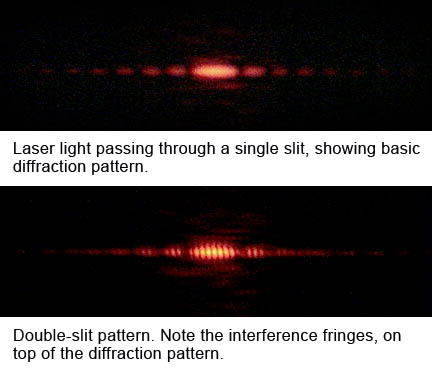
Young's double-slit experiment is the textbook demonstration that light behaves as a wave: light passing through two closely spaced slits interferes on a distant screen, producing alternating bright and dark fringes. The spacing of those fringes depends simply on the wavelength, the slit separation, and the screen distance.Beyond its historical role in settling the wave-versus-particle debate about light, this same interference relationship underlies the design of interferometers used for precision length measurement and the resolution limits of optical instruments.
The fringe spacing on the screen is Δy = λL/d. where lambda_y is the light wavelength, L_screen is the distance from the slits to the screen, d_slit is the separation between the two slits, and dy_fringe is the resulting fringe spacing.
Inputs
lambda_y := 600 nm=6e-04 mm
L_screen := 2 m=2 m
d_slit := 0.5 mm=0.5 mm
Multiply the wavelength by the screen distance and divide by the slit separation — this scales the microscopic wavelength up to a fringe spacing large enough to see on a screen.
dy_fringe := lambda_y·L_screen/d_slit=2.4 mm
Results
With visible light, millimeter-scale slit spacing, and a screen a couple of meters away, the fringes end up spaced on the order of a couple of millimeters apart — easily visible to the eye, which is why this classic setup works as a benchtop physics demonstration. Moving the screen farther away or using narrower slit spacing d stretches the fringes wider apart, since Δy is inversely proportional to d.
Assumptions & limitations
- Slit separation much smaller than the screen distance (small-angle/paraxial approximation).
- Monochromatic, coherent light source.
- Slits much narrower than their separation.