Vector Cross Product Magnitude
Vector Cross Product Magnitude
The cross product produces a new vector perpendicular to both inputs, with a magnitude equal to the area of the parallelogram they span — this is exactly the quantity behind torque (force cross lever arm), angular momentum, and the normal vector to a surface defined by two edge vectors.Unlike the dot product, the cross product depends on the order of the vectors (a×b = −b×a) and only exists in this simple component form in three dimensions, which is why it is written out here component by component rather than through a matrix function.
The cross product components are c_x = a_2b_3−a_3b_2, c_y = a_3b_1−a_1b_3, c_z = a_1b_2−a_2b_1, and its magnitude is |c| = sqrt(c_x²+c_y²+c_z²). where a_1c, a_2c, a_3c are the components of vector a, b_1c, b_2c, b_3c are the components of vector b, and c_x, c_y, c_z are the components of the resulting cross-product vector.
Inputs
a_1c := 3=3
a_2c := -1=-1
a_3c := 2=2
b_1c := 1=1
b_2c := 4=4
b_3c := 0=0
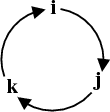
The x-component of the cross product comes from the "opposite" y and z components of the two vectors, following the cyclic pattern of the determinant expansion.
c_x := a_2c·b_3c - a_3c·b_2c=-8
The y-component follows the same cyclic pattern shifted one step.
c_y := a_3c·b_1c - a_1c·b_3c=2
The z-component completes the cycle.
c_z := a_1c·b_2c - a_2c·b_1c=13
The magnitude of the resulting vector is its length by the Pythagorean theorem, and equals the area of the parallelogram spanned by a and b.
mag_c := sqrt(c_x^2+c_y^2+c_z^2)=15.39
Results
A nonzero cross-product magnitude confirms the two vectors are not parallel; the value itself equals the area of the parallelogram they span, which is exactly the moment arm effect used when computing torque as r×F. If the two input vectors were parallel, every component of c would come out zero, signaling no perpendicular "twisting" effect between them.
Assumptions & limitations
- Vectors given in a common right-handed Cartesian coordinate system.
- Result direction (not computed here) is perpendicular to both input vectors by the right-hand rule.
- Only the magnitude, not the direction, is reported.